
Learn everything about IPTV Encoder technology in 2026. Discover features, benefits, encoding protocols, use cases, and how to choose the best IPTV encoder.
IPTV Encoder: Complete Guide to IPTV Encoding Technology in 2026
What Is an IPTV Encoder?
An IPTV encoder is a hardware or software device that converts video and audio signals into digital streams that can be delivered over an Internet Protocol Television (IPTV) network. IPTV encoders play a critical role in broadcasting live TV channels, sports events, video-on-demand content, and other multimedia services through the internet.
In modern IPTV systems, the encoder captures video from sources such as satellite receivers, cameras, cable boxes, or media servers and compresses the content into efficient formats like H.264 (AVC) or H.265 (HEVC). The encoded stream is then transmitted to IPTV middleware, content delivery networks (CDNs), or streaming servers for distribution to viewers.
As IPTV adoption continues to grow worldwide, IPTV encoders have become essential tools for broadcasters, content creators, educational institutions, hotels, enterprises, and streaming service providers.
Why IPTV Encoders Are Important
Without an IPTV encoder, raw video signals would consume excessive bandwidth and be difficult to deliver efficiently across networks. IPTV encoders help by:
- Compressing video content for efficient transmission
- Reducing bandwidth consumption
- Improving streaming quality
- Supporting multiple streaming protocols
- Enabling live broadcasting
- Enhancing scalability for IPTV services
- Supporting HD, Full HD, 4K, and even 8K streaming
A reliable IPTV encoder ensures viewers receive smooth, high-quality content with minimal buffering and latency.
How an IPTV Encoder Works
The IPTV encoding process involves several stages:
1. Video Input Capture
The encoder receives video from various sources, including:
- HDMI devices
- SDI cameras
- Satellite receivers
- Cable TV boxes
- CCTV systems
- Media players
2. Signal Processing
The incoming video and audio signals are analyzed and prepared for compression.
3. Compression
The encoder compresses data using codecs such as:
- H.264/AVC
- H.265/HEVC
- MPEG-4
- AAC Audio
Compression significantly reduces file size while maintaining video quality.
4. Stream Packaging
The compressed content is packaged into streaming formats suitable for IPTV delivery.
5. Network Transmission
The encoded stream is transmitted using IPTV protocols and delivered to end users through IPTV applications, smart TVs, mobile devices, and set-top boxes.
Types of IPTV Encoders
Hardware IPTV Encoders
Hardware encoders are dedicated physical devices designed specifically for video encoding.
Advantages
- High reliability
- Low latency
- Stable performance
- Suitable for professional broadcasting
- Supports continuous operation
Best For
- IPTV providers
- TV broadcasters
- Sports streaming
- Corporate video distribution
Software IPTV Encoders
Software encoders run on computers or servers and use processing power to encode video streams.
Advantages
- Lower initial cost
- Easy configuration
- Flexible deployment
- Frequent software updates
Best For
- Small IPTV businesses
- Content creators
- Educational institutions
- Startup streaming services
Key Features of a Modern IPTV Encoder
When selecting an IPTV encoder, look for the following features:
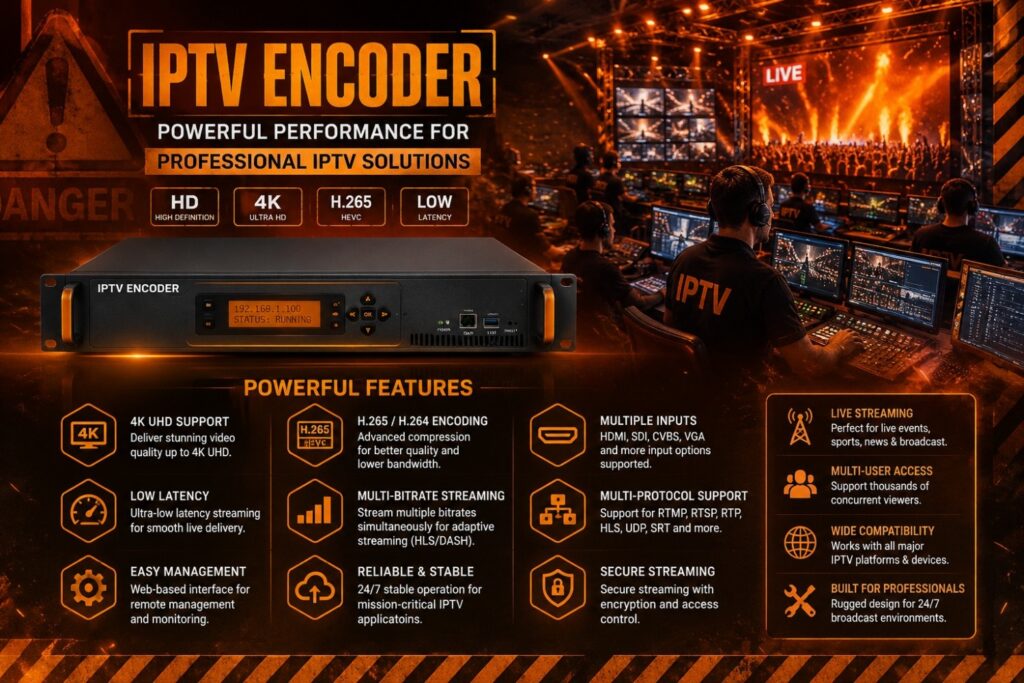
Multiple Video Inputs
Support for:
- HDMI
- SDI
- VGA
- CVBS
High-Efficiency Codecs
Modern encoders should support:
- H.264
- H.265/HEVC
These codecs provide excellent quality while minimizing bandwidth usage.
Multi-Bitrate Streaming
Allows simultaneous streaming at different resolutions and bitrates.
Low Latency Encoding
Critical for:
- Live sports
- News broadcasting
- Interactive streaming
4K UHD Support
As 4K content becomes standard, encoder compatibility is increasingly important.
Protocol Compatibility
Support for:
- RTMP
- RTP
- RTSP
- SRT
- HLS
- UDP
- HTTP
Remote Management
Web-based management panels allow administrators to configure and monitor encoders remotely.
Benefits of Using an IPTV Encoder
Improved Streaming Quality
Professional IPTV encoders optimize video quality while maintaining efficient bandwidth utilization.
Lower Bandwidth Costs
Advanced compression reduces network expenses and server load.
Scalability
Easily support thousands of simultaneous viewers.
Enhanced Reliability
Dedicated IPTV encoding solutions ensure uninterrupted content delivery.
Broad Device Compatibility
Streams can be viewed on:
- Smart TVs
- Android devices
- iPhones
- Tablets
- PCs
- IPTV boxes
IPTV Encoder Applications
IPTV Service Providers
Providers use encoders to distribute television channels and on-demand content.
Live Event Streaming
Concerts, conferences, webinars, and sporting events rely heavily on IPTV encoding technology.
Educational Institutions
Schools and universities use IPTV systems for distance learning and campus broadcasting.
Hospitality Industry
Hotels utilize IPTV platforms to deliver entertainment and informational channels to guests.
Corporate Communications
Businesses stream internal meetings, training programs, and company announcements.
Surveillance Systems
Security networks use IPTV encoders to distribute CCTV footage across locations.
IPTV Encoder Protocols Explained
RTMP
Popular for live streaming to platforms and streaming servers.
HLS
Widely used for adaptive streaming on mobile devices and smart TVs.
SRT
Provides secure, reliable video transport with low latency.
RTSP
Commonly used for surveillance and IP camera applications.
UDP
Offers fast delivery with minimal overhead.
Choosing the right protocol depends on network conditions, latency requirements, and audience size.
IPTV Encoder vs IPTV Transcoder
Many users confuse IPTV encoders and transcoders.
IPTV Encoder
- Converts raw video signals into digital streams
- Captures content from physical sources
- Creates initial IPTV streams
IPTV Transcoder
- Converts existing streams into different formats
- Changes bitrate or resolution
- Optimizes content for multiple devices
In many IPTV infrastructures, both technologies work together.
Factors to Consider Before Buying an IPTV Encoder
Video Quality Requirements
Determine whether you need:
- HD
- Full HD
- 4K UHD
Number of Channels
Some encoders support a single channel while others handle dozens simultaneously.
Codec Support
H.265 support can significantly reduce bandwidth costs.
Network Infrastructure
Ensure compatibility with your existing IPTV architecture.
Budget
Balance cost with performance requirements.
Technical Support
Reliable vendor support can simplify deployment and maintenance.
Future Trends in IPTV Encoding
The IPTV industry continues evolving rapidly.
AI-Based Encoding
Artificial intelligence is improving compression efficiency and video quality.
Wider Adoption of HEVC
H.265 continues gaining popularity due to superior bandwidth efficiency.
AV1 Codec Integration
AV1 promises even greater compression performance for future IPTV platforms.
Cloud Encoding
Cloud-based IPTV encoding solutions reduce hardware costs and increase scalability.
8K Streaming
Advanced encoders are beginning to support ultra-high-resolution broadcasting.
Enhanced Security
Future IPTV encoders will include stronger encryption and content protection features.
Common IPTV Encoder Challenges
Although IPTV encoders offer many benefits, users may encounter:
- Network congestion
- Insufficient bandwidth
- Hardware failures
- Configuration errors
- Codec incompatibility
- High CPU usage in software encoders
Proper planning and professional deployment can minimize these issues.
Best Practices for IPTV Encoding
To maximize performance:
- Use H.265 whenever supported.
- Optimize bitrate settings.
- Monitor network utilization.
- Keep firmware updated.
- Implement redundancy for critical streams.
- Test streams before going live.
- Utilize adaptive bitrate streaming.
These practices help maintain stable and high-quality IPTV delivery.
Conclusion
An IPTV encoder is one of the most important components in any IPTV infrastructure. It transforms video content into efficient digital streams that can be distributed across networks and viewed on virtually any device. Whether you’re launching a new IPTV service, broadcasting live events, managing a hotel entertainment system, or operating an enterprise streaming platform, selecting the right IPTV encoder is essential for achieving excellent video quality, low latency, and scalable performance.
As technologies such as AI-powered encoding, cloud streaming, AV1 compression, and 8K broadcasting continue to evolve, IPTV encoders will remain at the center of modern video delivery systems. Investing in a high-quality IPTV encoder today can help future-proof your streaming operations and ensure a superior viewing experience for your audience.
FAQs
What is an IPTV encoder used for?
An IPTV encoder converts video and audio signals into digital streams that can be delivered through IPTV networks.
Which codec is best for IPTV encoding?
H.265 (HEVC) is generally considered the most efficient codec due to its superior compression capabilities.
Can IPTV encoders support 4K streaming?
Yes. Many modern IPTV encoders support 4K Ultra HD streaming.
What is the difference between hardware and software IPTV encoders?
Hardware encoders are dedicated devices offering higher reliability, while software encoders run on computers and provide greater flexibility.
Is low latency important in IPTV encoding?
Yes. Low latency is critical for live sports, gaming, news broadcasts, and interactive streaming applications.
Can IPTV encoders work with cloud streaming platforms?
Yes. Many modern IPTV encoders integrate seamlessly with cloud-based streaming and CDN infrastructures.