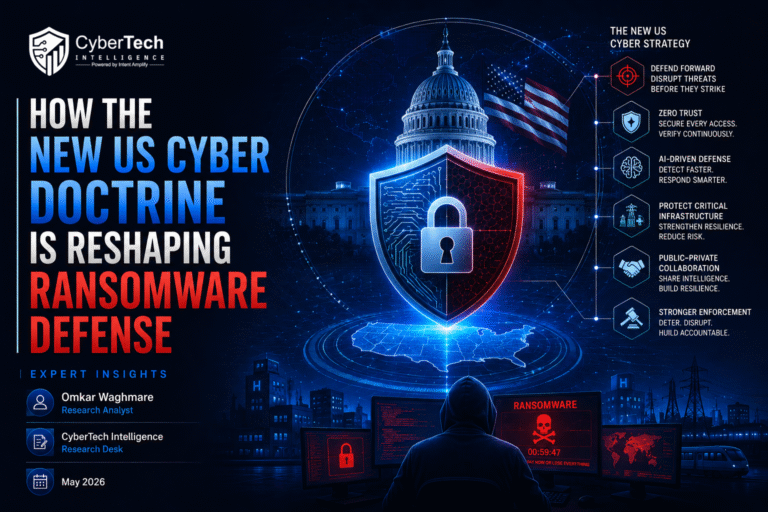

Ransomware attacks have evolved into one of the most disruptive and financially damaging cybersecurity threats facing organizations worldwide. What once began as isolated attacks targeting individual systems has now transformed into highly sophisticated, large-scale cybercrime operations driven by organized ransomware groups employing multi-extortion tactics, double extortion schemes, and advanced social engineering techniques. From healthcare and financial institutions to critical infrastructure and government agencies, no sector remains immune to the growing impact of ransomware-driven cyberattacks.
As ransomware threats continue escalating in scale and complexity, governments and cybersecurity agencies are redefining their strategies to strengthen national cyber defense capabilities. The emergence of the new U.S. cyber doctrine marks a significant shift in how ransomware threats are being addressed at both national and enterprise levels. Rather than focusing solely on reactive incident response, the updated doctrine emphasizes proactive defense, disruption of cybercriminal ecosystems, international collaboration, and stronger public-private cybersecurity partnerships.
This expert insight explores how the evolving U.S. cyber doctrine is reshaping ransomware defense strategies and influencing enterprise cybersecurity frameworks across industries. The article highlights how organizations are being encouraged to move beyond traditional perimeter-based security models and adopt more resilient, intelligence-driven cybersecurity approaches capable of responding to modern ransomware operations.
One of the most significant changes introduced through the evolving cyber doctrine is the increased focus on prevention and operational resilience. Enterprises are now expected to implement stronger zero-trust architectures, continuous monitoring systems, advanced threat intelligence capabilities, and incident response preparedness measures to minimize ransomware exposure. Security leaders are increasingly prioritizing cyber resilience strategies that allow organizations to maintain operational continuity even during active attacks.
The article also examines the growing use of multi-extortion ransomware tactics, where attackers not only encrypt data but also threaten to leak sensitive information, disrupt business operations, or target customers and partners unless ransom demands are met. This shift has significantly increased both the financial and reputational risks associated with ransomware incidents. As a result, organizations must now prepare for broader crisis management scenarios that extend beyond technical recovery alone.
Another major theme discussed is the role of intelligence sharing and collaboration between government agencies, law enforcement, and private enterprises. The new cyber doctrine emphasizes the importance of collective defense strategies where organizations actively share threat intelligence, indicators of compromise (IOCs), attack patterns, and security insights to improve industry-wide resilience against ransomware campaigns. This collaborative approach is becoming increasingly critical as ransomware groups continue operating across global and decentralized cybercrime networks.
The article further explores how evolving regulatory expectations and cybersecurity compliance requirements are pushing enterprises to strengthen ransomware preparedness. Organizations are being encouraged to adopt stronger backup and recovery strategies, multi-factor authentication, employee cybersecurity awareness training, privileged access management, and rapid incident containment procedures to reduce the likelihood and impact of successful attacks.
In addition to defensive strategies, the updated cyber doctrine also signals a more aggressive stance toward disrupting ransomware infrastructure and cybercriminal operations. Governments are increasingly leveraging offensive cyber capabilities, sanctions, international coordination, and law enforcement actions to target ransomware gangs, disrupt financial networks, and dismantle cybercrime ecosystems that enable these attacks to thrive.
The financial and operational consequences of ransomware attacks continue to grow, with businesses facing downtime, regulatory penalties, legal exposure, reputational damage, and long-term customer trust issues. In this rapidly evolving threat landscape, organizations can no longer rely solely on traditional cybersecurity models. Building ransomware resilience now requires a combination of advanced technology, strategic planning, organizational readiness, and cross-sector collaboration.
As ransomware continues to evolve into a global cybersecurity crisis, enterprises that proactively align their security strategies with emerging cyber defense doctrines will be better positioned to protect critical assets, respond effectively to attacks, and maintain business continuity in an increasingly hostile digital environment.
Read the full article to discover how the new U.S. cyber doctrine is transforming ransomware defense strategies and why proactive cyber resilience is becoming essential for modern enterprises. @ https://tinyurl.com/2p9zmseb
Contact Us
1846 E Innovation Park Dr, Suite 100, Oro Valley, AZ 85755
Phone: +1 (845) 347-8894, +91 77760 9266