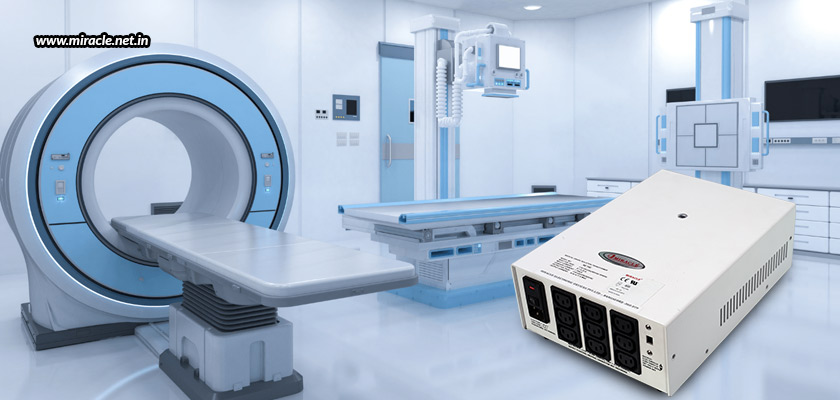

Modern healthcare depends on imaging and diagnostic technologies like MRI, CT, ultrasound, and digital X-ray systems for accurate disease detection and treatment planning. These devices require stable, clean, and interference-free power to function reliably. However, electrical disturbances such as voltage fluctuations, harmonics, EMI, and transient surges can affect image quality and equipment performance. Medical isolation transformers address these challenges by electrically isolating sensitive systems from power network disturbances. They filter noise, stabilize voltage, and protect critical equipment, ensuring consistent accuracy. This makes them essential for maintaining reliability, precision, and safety in modern diagnostic and imaging environments.
The importance of clean power in medical imaging
Diagnostic equipment operates by capturing and processing highly sensitive signals that require exceptional electrical precision. MRI systems detect subtle magnetic responses from the human body, CT scanners reconstruct detailed cross-sectional images using accurate detector inputs, and ultrasound machines interpret returning sound-wave signals in real time. These technologies depend heavily on stable power quality for consistent performance. Any irregularity in electrical supply can disrupt imaging accuracy. Voltage fluctuations may cause inconsistent operation, while electromagnetic interference can distort signals and reduce image clarity. Harmonic distortion from surrounding systems further increases instability and calibration errors. In busy hospital environments, multiple high-power devices such as elevators, HVAC systems, and surgical equipment generate continuous electrical noise. Medical isolation transformers help eliminate these disturbances, ensuring clean power delivery and reliable diagnostic performance.
How medical isolation transformers enhance imaging system performance and patient safety
Medical isolation transformers ensure stable power, reduce electrical noise, improve imaging accuracy, enhance safety, and support reliable hospital diagnostic operations.
- Minimizing ground loops and electrical noise
Ground loops occur when multiple grounding paths create unwanted circulating currents, which are common in complex hospital environments with interconnected medical systems. These loops can introduce electrical interference, signal distortion, imaging artifacts, and unstable readings. Medical isolation transformers eliminate these unwanted current paths by providing electrical separation from the primary supply. This reduces noise and improves diagnostic signal integrity.
- Protecting diagnostic accuracy
Diagnostic accuracy relies on both advanced imaging systems and a stable electrical environment. Poor power quality can introduce subtle errors that affect interpretation across MRI, CT, and ultrasound systems. Isolation transformers deliver clean, stable power, reducing artifacts, improving detector consistency, and enhancing image resolution. This ensures more reliable diagnoses, fewer repeat scans, and improved clinical decision-making efficiency.
- Enhancing safety in imaging environments
Imaging departments contain high-power medical equipment operating close to patients and healthcare staff, creating electrically sensitive environments. Isolation transformers improve safety by reducing leakage currents and minimizing the risk of electrical shock. By isolating equipment from the main power supply, they create safer operating conditions, especially when patients are connected to monitoring devices during diagnostic procedures.
- Supporting hospital power infrastructure
Modern hospitals require reliable, scalable electrical infrastructure to support expanding imaging and diagnostic services. Isolation transformers provide localized power conditioning, ensuring stable energy delivery within imaging suites. They also enable electrical separation between departments, preventing disturbances from equipment such as elevators or surgical tools from affecting diagnostic systems. This zonal isolation strengthens overall hospital power reliability.
- Reducing downtime and maintenance costs
Unplanned downtime in imaging systems disrupts hospital workflows, delays diagnoses, and impacts patient care. Electrical disturbances are a major cause of unexpected equipment failures. Isolation transformers protect sensitive systems from such fluctuations, improving uptime and reducing repair frequency. This leads to lower maintenance costs, fewer operational interruptions, and more efficient long-term performance of diagnostic equipment.
The role of medical isolation transformers in MRI systems
Medical isolation transformers reduce electrical noise, stabilize power supply, improve image clarity, and ensure safe, reliable MRI system performance.
- Reducing electromagnetic interference
MRI rooms contain multiple electronic subsystems such as gradient amplifiers, RF coils, cooling units, and control consoles, all of which must operate with high precision. External electrical noise from hospital equipment can introduce interference and imaging artifacts. Isolation transformers reduce common-mode noise, block unwanted electrical disturbances, and maintain clean signal pathways, ensuring sharper MRI image quality.
- Stabilizing voltage for consistent performance
MRI systems require substantial electrical power, particularly during high-intensity imaging sequences. Any fluctuation in voltage can disrupt calibration, affect scan timing, or cause interruptions during procedures. Isolation transformers regulate incoming power and provide stable voltage throughout the imaging cycle. This stability ensures consistent system performance, reduces operational errors, and supports uninterrupted, high-quality diagnostic imaging processes.
- Protecting expensive components
MRI machines are high-value diagnostic investments containing sensitive electronic and superconducting components. Power surges, spikes, and transient disturbances can damage internal circuits and lead to expensive repairs or system downtime. Isolation transformers act as a protective barrier, absorbing electrical irregularities and preventing them from reaching critical components, thereby enhancing equipment safety, reliability, and long-term operational life.
The role of medical isolation transformers in CT scanners
Stable electrical performance ensures minimal noise, consistent imaging quality, reduced artifacts, and precise diagnostic results in clinical environments, consistently reliable.
- Preventing image distortion
CT imaging systems process large volumes of data in very short time intervals, making them highly sensitive to electrical disturbances. Noise, harmonics, and transient fluctuations can reduce detector accuracy and introduce errors in image reconstruction. Medical isolation transformers stabilize power supply, filter electrical interference, and ensure consistent signal quality for sharper, more reliable diagnostic images.
- Supporting continuous operation
Hospitals rely on CT scanners in emergency rooms, trauma units, and diagnostic centres where uninterrupted operation is critical. Power fluctuations or sudden voltage spikes can disrupt scanning procedures and cause system shutdowns, delaying patient care. Isolation transformers enhance electrical stability, protect sensitive circuits, and ensure CT systems operate continuously without unexpected interruptions or downtime.
- Enhancing system longevity
CT scanners contain highly sensitive components such as detectors, processors, and cooling systems that are vulnerable to unstable electrical conditions. Repeated exposure to voltage variations can increase wear and reduce performance over time. Medical isolation transformers reduce electrical stress, improve power quality, and help extend the operational lifespan of critical CT system components while lowering maintenance needs.
The role of medical isolation transformers in Ultrasound systems
Ultrasound systems rely on sensitive transducers and advanced signal processing to deliver real-time imaging with high accuracy and clarity.
- Eliminating signal noise
Ultrasound imaging depends on detecting very subtle electrical signal variations returned from tissue interfaces. External electrical interference from nearby hospital equipment can introduce unwanted noise, reducing image clarity and diagnostic precision. Isolation transformers create a stable electrical environment by blocking electromagnetic interference and reducing ground-loop currents, ensuring cleaner signals and significantly improving ultrasound image accuracy.
- Supporting portable and bedside ultrasound units
Portable and bedside ultrasound systems are widely used in ICUs, emergency departments, and operating rooms where multiple electronic devices operate simultaneously. This crowded electrical environment increases the risk of interference and unstable power conditions. Isolation transformers provide stable, clean power, reduce electrical disturbances, and ensure consistent imaging performance, enabling reliable real-time diagnostics at the point of care.
Medical imaging and diagnostic equipment are among the most advanced and critical systems in healthcare, requiring highly stable and clean electrical power for accurate performance. Medical isolation transformers play a vital role in protecting MRI, CT, ultrasound, and other diagnostic systems from EMI, surges, harmonics, and voltage fluctuations. By ensuring reliable and interference-free power, they enhance diagnostic accuracy, improve patient safety, reduce equipment downtime, and extend the lifespan of expensive medical devices. Miracle Electronics provides reliable isolation transformer for medical application solutions that ensure stable, clean power for sensitive medical equipment. These transformers enhance diagnostic accuracy, reduce electrical noise, and support safe, uninterrupted hospital operations.