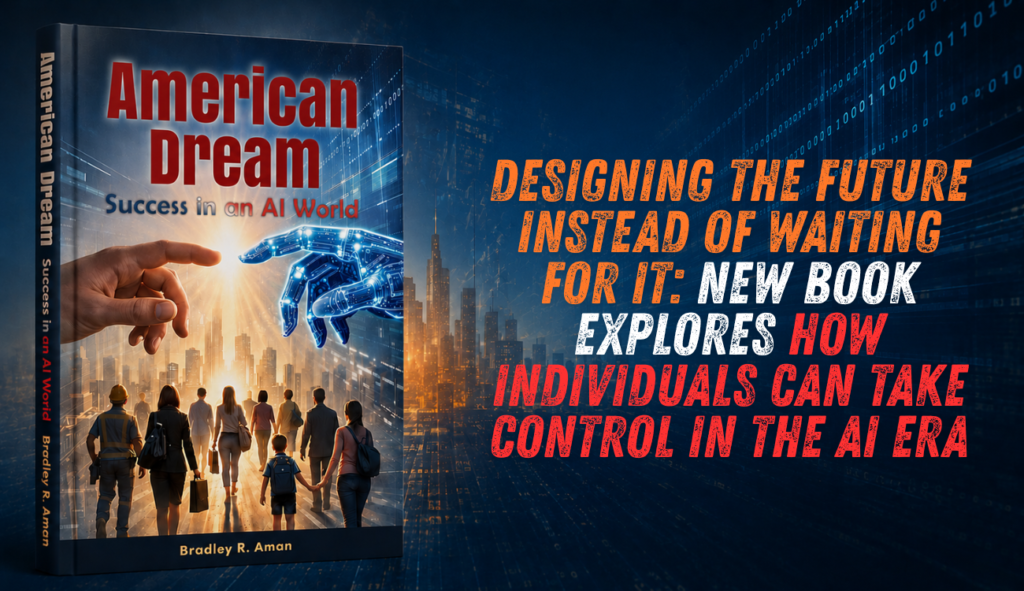

There is a natural tendency to think of the future as something that arrives.
Something that unfolds over time, shaped by forces beyond individual control. Technology advances. industries evolve. new systems emerge. And people, for the most part, adjust as those changes become clear.
But what if the future is not only something that happens?
What if it is also something that can be shaped?
In American Dream AI, author Bradley R. Aman reflects on this question with a focus that shifts the perspective from reaction to intention. Not in a way that ignores uncertainty, but in a way that acknowledges the role individuals can play in navigating it.
Because while artificial intelligence is transforming how work is done, it is also changing how direction is chosen.
There is a difference between following a path and designing one.
For many, career progression has traditionally followed a structure.
A role is defined. Expectations are clear. Advancement occurs within a system that, while competitive, is at least visible. The path may not be easy, but it is recognizable.
Artificial intelligence introduces a different dynamic.
It does not eliminate structure, but it expands what exists outside of it. It creates new ways to approach work, new ways to build, and new ways to think about how value is created over time.
This expansion is not always obvious.
It requires a shift in perspective.
The book explores this shift carefully.
It suggests that as tools become more accessible, the ability to create becomes more distributed. That individuals are no longer limited to participating within predefined roles, but can begin to shape how they contribute.
This does not require dramatic change.
It often begins in small ways.
A different approach to a familiar task.
A new tool explored out of curiosity.
An idea tested without certainty of outcome.
These actions may seem minor.
But they represent something larger.
The beginning of intentional movement.
There is also a distinction made between control and direction.
Control implies certainty.
A clear understanding of outcomes and the ability to influence them directly.
Direction is different.
It exists even when outcomes are not fully known. It is shaped by decisions made over time, each one influencing the next.
In a changing environment, direction becomes more valuable than control.
Because while the future cannot be predicted in detail, it can be approached with intention.
This idea carries through the work.
That individuals are not expected to have a complete plan.
They are encouraged to begin.
To engage with the tools available to them. To develop skills that extend beyond a single function. To remain open to adjusting their path as new information becomes available.
This process is not linear.
It involves uncertainty.
Moments of hesitation.
Periods of exploration.
Times when progress is not immediately visible.
But over time, these experiences contribute to something more structured.
A sense of direction that develops gradually, shaped by action rather than assumption.
There is also an emphasis on ownership.
Not in the sense of possession, but in the sense of responsibility.
The understanding that while external systems influence opportunity, individual engagement influences outcome.
This is not framed as pressure.
It is presented as awareness.
That the ability to shape a path exists, even within uncertainty.
And that choosing not to engage is, in itself, a form of decision.
The book does not suggest that traditional paths no longer hold value.
They do.
But it expands the conversation.
It introduces the idea that alongside those paths, there is space for something else.
Something more flexible.
More responsive.
More aligned with the realities of a changing environment.
There is also a recognition that designing a future does not happen all at once.
It develops over time.
Through repetition.
Through reflection.
Through the willingness to adjust when something no longer fits.
This gradual process may not always feel significant in the moment.
But its impact becomes clearer with distance.
Because direction, once established, begins to influence not just decisions, but outcomes.
The tone throughout remains grounded.
There are no assumptions that the process is simple.
No guarantees of specific results.
Instead, there is a consistent emphasis on engagement.
On the idea that meaningful change—whether personal or professional—begins with participation.
In this way, American Dream AI presents the future not as something fixed.
But as something shaped through interaction.
Through the choices individuals make, the actions they take, and the willingness they have to move forward even when certainty is limited.
And while that may not remove the complexity of what lies ahead, it introduces something equally important.
Possibility.
For more information about American Dream AI or to schedule an interview with Bradley R. Aman, please contact:
Media Contact
Author Name: Bradley R Aman
Amazon: AMERICAN DREAM: Success in an Al World
Website: www.youramericadream.com
https://www.youtube.com/@YourAmericanDreamer/shorts
https://www.facebook.com/profile.php?id=61583530424497#
https://www.instagram.com/_youramericandream_