
INTRODUCTION
The success of fertility treatments largely depends on the quality, safety, and environmental stability of the laboratory where critical reproductive procedures are performed. This is why proper IVF Laboratory Design is considered one of the most important aspects of building a successful fertility clinic. IVF laboratories must maintain highly controlled conditions that protect embryos, gametes, and reproductive tissues from contamination, environmental fluctuations, and operational risks.
Unlike conventional medical laboratories, IVF labs require advanced cleanroom engineering, precision HVAC systems, contamination control measures, and strict environmental monitoring. To ensure these conditions are maintained consistently, IVF laboratories must follow various national and international standards related to healthcare infrastructure, air quality, cleanroom engineering, infection control, and laboratory safety.
Importance of Standards in IVF Laboratory Design
IVF laboratories handle highly sensitive reproductive materials that can easily be affected by environmental changes.
Standards Help Ensure:
- Air quality control
- Contamination prevention
- Temperature stability
- Humidity regulation
- Sterile conditions
- Equipment reliability
Following standards improves laboratory safety and operational consistency.
Why IVF Laboratories Need Controlled Environments
Embryos and reproductive cells are extremely sensitive to pollutants and environmental instability.
Controlled Environments Help:
- Protect embryo viability
- Reduce contamination risks
- Improve fertilization success
- Maintain stable laboratory conditions
A properly controlled laboratory directly supports IVF success rates.
ICMR Guidelines for IVF Laboratories
In India, IVF laboratories must comply with guidelines established by the Indian Council of Medical Research (ICMR).
ICMR Guidelines Cover:
- Laboratory infrastructure
- Air quality requirements
- Equipment standards
- Sterility protocols
- Quality control systems
ICMR compliance is essential for Indian fertility clinics.
ART Regulations and Compliance
Assisted Reproductive Technology (ART) regulations also influence IVF Laboratory Design.
ART Standards Include:
- Laboratory safety protocols
- Cryopreservation guidelines
- Record management systems
- Embryology workflow requirements
ART compliance supports safe reproductive practices.
ISO Cleanroom Standards
IVF laboratories often follow ISO cleanroom standards for contamination control.
Commonly Referenced Standards Include:
- ISO 14644 cleanroom standards
- Particle count classifications
- Air cleanliness requirements
These standards help maintain controlled cleanroom environments.
Importance of ISO 14644 Standards
ISO 14644 defines cleanroom classifications based on airborne particle concentration.
Benefits Include:
- Better contamination management
- Standardized cleanroom performance
- Improved air quality monitoring
ISO standards support laboratory consistency.
NABH Guidelines for Healthcare Facilities
NABH standards are important for healthcare accreditation in India.
NABH Requirements Include:
- Infection control systems
- HVAC performance
- Safety management
- Sterile workflow planning
Compliance improves operational quality and accreditation readiness.
HVAC Standards in IVF Laboratory Design
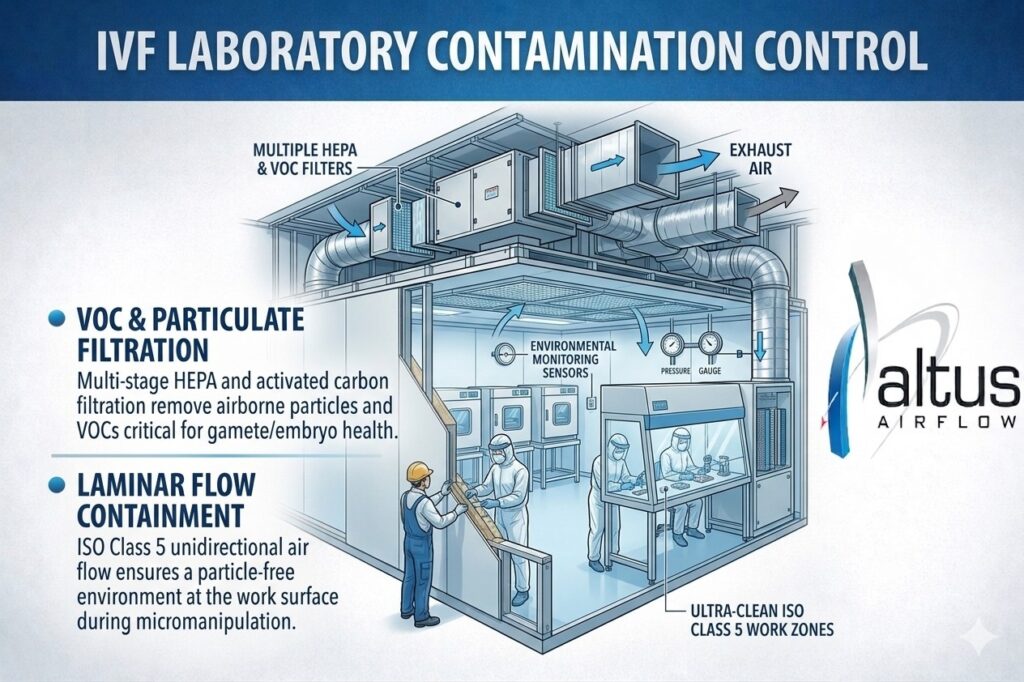
HVAC systems are among the most critical components of IVF laboratories.
HVAC Standards Include:
- Air filtration requirements
- Air exchange rates
- Temperature stability
- Humidity control
- Pressure balancing
Proper HVAC systems maintain cleanroom stability.
Importance of HEPA Filtration Standards
HEPA filters are essential for maintaining clean air quality.
HEPA Standards Help:
- Remove airborne particles
- Reduce microbial contamination
- Improve embryo protection
HEPA filters typically remove 99.97% of particles ≥0.3 microns.
Laminar Airflow Requirements
Laminar airflow systems support contamination control.
Laminar Airflow Standards Include:
- Unidirectional airflow
- Controlled air velocity
- Reduced turbulence
Proper airflow design improves sterile conditions.
Recommended Air Change Rates
Air Changes Per Hour (ACH) are important for IVF laboratories.
Recommended ACH Levels:
Typically between 15–20 ACH depending on laboratory zones.
Proper air circulation improves contaminant removal.
Positive Pressure Standards
Positive pressure systems prevent contaminated air from entering clean areas.
Positive Pressure Helps:
- Maintain cleanroom integrity
- Improve contamination control
- Protect embryo culture environments
Pressure balancing is a critical HVAC requirement.
Temperature Control Standards
Stable temperature conditions are essential in IVF laboratories.
Recommended Temperature Range:
Usually between 22°C and 26°C depending on laboratory areas.
Temperature fluctuations can affect embryo development.
Humidity Control Standards
Relative humidity must also remain stable.
Recommended Humidity Levels:
Typically between 40% and 60%.
Humidity control reduces microbial growth and static electricity.
VOC Control Standards
Volatile Organic Compounds (VOCs) can negatively affect embryos.
VOC Control Measures Include:
- Low-VOC construction materials
- Advanced air filtration systems
- Proper ventilation engineering
VOC management improves laboratory safety.
Importance of Air Quality Monitoring
Continuous air quality monitoring is essential.
Monitoring Systems Track:
- Particle concentration
- VOC levels
- Temperature
- Humidity
- Pressure differentials
Environmental monitoring supports consistent laboratory performance.
Cleanroom Zoning Standards
Proper zoning minimizes contamination risks.
IVF Laboratory Zones Include:
- Embryology lab
- Andrology lab
- Cryopreservation area
- Sterile preparation areas
Controlled zoning improves workflow efficiency.
Material Standards in IVF Laboratory Design
Construction materials must support hygiene and contamination control.
Common Material Standards Include:
- Non-porous surfaces
- Antibacterial finishes
- Seamless construction materials
- Chemical-resistant surfaces
Material selection affects long-term cleanliness.
Flooring Standards for IVF Laboratories
Flooring systems should support cleanroom functionality.
Recommended Flooring Includes:
- Seamless vinyl flooring
- Conductive flooring
- Epoxy flooring
These materials reduce contamination accumulation.
Modular Wall Panel Standards
Modular wall systems improve cleanroom performance.
Wall Panel Requirements Include:
- Smooth surfaces
- Chemical resistance
- Easy cleaning capability
Seamless walls reduce microbial buildup.
Electrical Safety Standards
Reliable electrical infrastructure is essential in IVF laboratories.
Electrical Standards Include:
- Backup power systems
- Voltage stabilization
- Grounding systems
- Isolated power supplies
Electrical stability protects sensitive laboratory equipment.
Medical Gas System Standards
Some IVF labs require integrated medical gas systems.
Medical Gas Standards Include:
- Safe pipeline installation
- Leak-proof systems
- Pressure monitoring
Proper gas systems support safe laboratory operations.
Fire Safety Standards
Healthcare laboratories must follow strict fire safety regulations.
Fire Safety Measures Include:
- Fire-resistant materials
- Smoke detection systems
- Emergency evacuation systems
Safety planning protects staff and patients.
Infection Control Standards
Infection prevention is a major priority in IVF Laboratory Design.
Infection Control Measures Include:
- HEPA filtration
- Laminar airflow
- Sterile zoning
- Cleanroom protocols
Proper infection control improves treatment safety.
Equipment Validation Standards
IVF laboratory equipment must undergo regular validation.
Validation Includes:
- Incubator calibration
- Temperature verification
- Airflow testing
- Equipment performance checks
Validation ensures operational reliability.
Importance of Calibration Standards
Regular calibration improves accuracy and consistency.
Calibration Applies To:
- Incubators
- Microscopes
- Temperature sensors
- Environmental monitoring systems
Calibration supports quality assurance.
Documentation and Record Management Standards
IVF laboratories must maintain detailed documentation.
Documentation Includes:
- Maintenance records
- Validation reports
- Environmental monitoring logs
- Equipment servicing reports
Accurate records support compliance and audits.
Staff Safety and Workflow Standards
Laboratory design should also protect healthcare staff.
Staff Safety Measures Include:
- Ergonomic workspace design
- Safe chemical handling areas
- Proper ventilation systems
Efficient workflow improves operational productivity.
Energy Efficiency Standards
Modern IVF laboratories increasingly adopt energy-efficient systems.
Energy-Efficient Features Include:
- Efficient HVAC systems
- LED lighting
- Smart environmental controls
Energy efficiency reduces operational costs.
Importance of Periodic Maintenance
Routine maintenance ensures compliance with operational standards.
Maintenance Includes:
- HVAC servicing
- HEPA filter replacement
- Airflow balancing
- Environmental monitoring verification
Maintenance supports long-term laboratory stability.
Benefits of Following Proper Standards
Key Benefits Include:
- Improved embryo protection
- Better contamination control
- Stable environmental conditions
- Enhanced patient safety
- Improved laboratory efficiency
Standards improve both operational and clinical performance.
Future Trends in IVF Laboratory Standards
Modern IVF labs increasingly use advanced technologies.
Emerging Trends Include:
- AI-based environmental monitoring
- IoT-enabled HVAC systems
- Smart cleanroom automation
- Advanced contamination control systems
Technology continues improving IVF laboratory safety and precision.
Importance of Choosing an Experienced Design Partner
A specialized IVF laboratory provider understands healthcare cleanroom standards and fertility lab requirements.
Experienced Providers Help With:
- Regulatory compliance
- HVAC engineering
- Cleanroom validation
- Environmental stability
Expertise improves long-term laboratory performance.
Conclusion
Following proper standards in IVF Laboratory Design is essential for maintaining sterile conditions, environmental stability, contamination control, and successful fertility treatment outcomes. IVF laboratories must comply with ICMR guidelines, ART regulations, ISO cleanroom standards, NABH requirements, HVAC specifications, HEPA filtration protocols, and infection control measures to create safe and reliable reproductive healthcare environments.
From cleanroom engineering and air quality management to temperature control and equipment validation, every aspect of IVF laboratory infrastructure must support embryo safety and operational precision. With expertise in healthcare cleanroom engineering and advanced fertility laboratory infrastructure, Altus Airflow delivers high-performance IVF laboratory solutions designed to meet modern healthcare standards and support long-term fertility clinic success.
Frequently Asked Questions (FAQs)
1. Why are standards important in IVF Laboratory Design?
Standards in IVF Laboratory Design help maintain contamination control, stable air quality, temperature regulation, and embryo safety.
2. Which guidelines apply to IVF Laboratory Design in India?
IVF Laboratory Design in India typically follows ICMR guidelines, ART regulations, NABH standards, and ISO cleanroom standards.
3. Why are HEPA filters important in IVF Laboratory Design?
HEPA filters used in IVF Laboratory Design remove airborne particles and improve cleanroom air quality.
4. What HVAC standards must IVF laboratories follow?
HVAC systems in IVF Laboratory Design must maintain proper airflow, temperature stability, humidity control, and pressure balancing.
5. How does cleanroom engineering support IVF laboratories?
Cleanroom engineering in IVF Laboratory Design helps reduce contamination, maintain sterile conditions, and improve embryo protection.
Read Our Previous Blog——>What services are offered by Modular Ophthalmic OT Manufacturers?