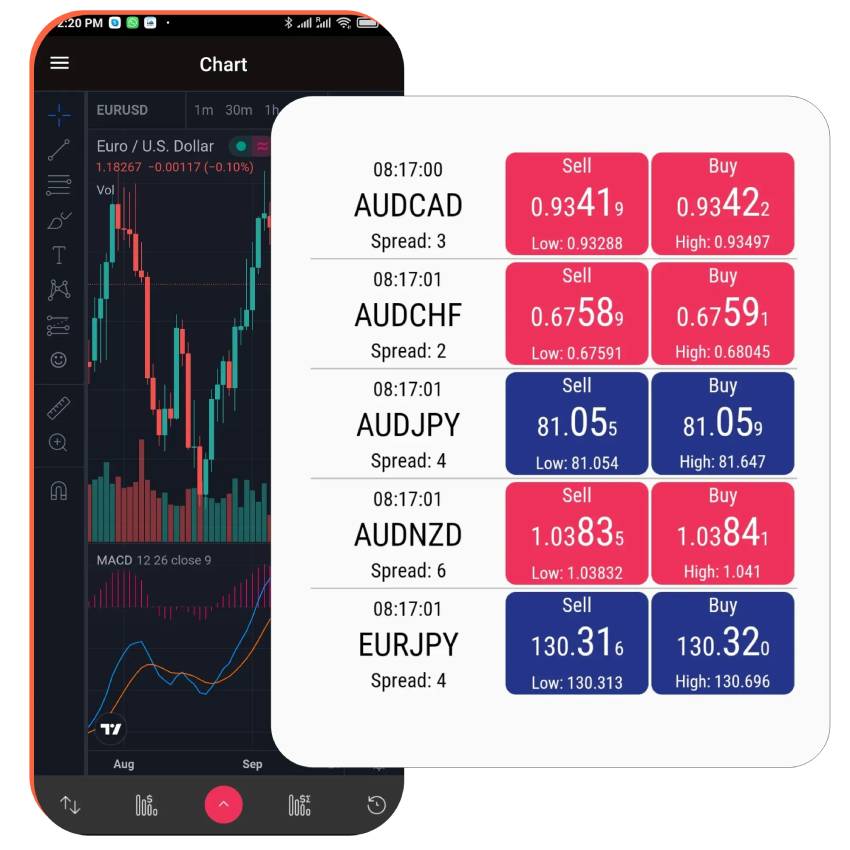

Maximize your market exposure with Tradex.live, the top margin trading platform in India. Borrow up to 500x funds to increase your trading capacity.
What Is Margin Trading? (In Plain English)
Margin trading means borrowing money from your broker to take a larger position than your own cash would allow. You put up a fraction of the total trade value — called the margin — and the broker funds the rest. If the trade works, your returns are calculated on the entire position, not just your own contribution. That’s the appeal.
A simple example: you have ₹10,000 and you want exposure to a stock or index worth ₹1,00,000. Without margin, you can only buy what your ₹10,000 buys. With 10x margin, your ₹10,000 acts as collateral and you control the full ₹1,00,000 position. If that position rises 2%, you’ve made ₹2,000 — a 20% return on your actual capital. If it falls 2%, the loss is also magnified the same way.
This is the entire concept. Everything else — initial margin, maintenance margin, margin calls, MTF interest, SPAN margin — is just the mechanics of how brokers and exchanges manage the risk of lending you that money.
The Margin Trading Terms You Actually Need to Know
-
Initial margin
The minimum amount you have to deposit upfront to open a position. Set by the exchange or broker based on the volatility of the underlying asset.
-
Maintenance margin
The minimum balance you must keep in your account while a position is open. If your balance falls below this, you’ll get a margin call.
-
Margin call
A notice from the broker that your account has dropped below the required maintenance level. You either add funds or the broker squares off your position. There’s no negotiation.
-
Leverage ratio
Expressed as something like 10x, 50x or 500x. A 10x ratio means every ₹1 of your capital controls ₹10 of trade value. Tradex1.live offers up to 500x on select instruments.
-
SPAN and exposure margin
Used in F&O. SPAN is calculated by the exchange based on potential worst-case loss. Exposure margin is an extra buffer. Together they make up the total margin needed for derivative positions.
-
MTF (Margin Trading Facility)
The SEBI-regulated facility where you can buy shares using broker funding. You pay interest on the borrowed amount until you square off.
-
Margin pledge
Using shares or other approved assets as collateral instead of (or in addition to) cash. Lets you free up funds while still keeping your investments.
Community
Join the TradeX community to avail the benefits!
How Leverage Actually Works — A Worked Example
| Leverage | Your Capital (Margin) Required | Total Trade Value | Profit if Stock Rises 2% | Return on Your Capital |
|---|---|---|---|---|
| 1x (no margin) | ₹1,00,000 | ₹1,00,000 | ₹2,000 | 2% |
| 10x | ₹10,000 | ₹1,00,000 | ₹2,000 | 20% |
| 50x | ₹2,000 | ₹1,00,000 | ₹2,000 | 100% |
| 100x | ₹1,000 | ₹1,00,000 | ₹2,000 | 200% |
How Leverage Actually Works — A Worked Example
How Margin Trading Works in India (The SEBI Bit)
Margin trading in India is regulated by SEBI and works slightly differently across segments:
- Cash equity (MTF) — SEBI allows brokers to offer a Margin Trading Facility on a defined list of approved stocks. You can fund up to ~75-80% of the trade value through the broker, paying interest on the borrowed portion. You hold the position for as long as you maintain margin.
- Intraday equity — Higher leverage is allowed for positions squared off the same day. SEBI revised intraday margin rules in 2020-2021 (the well-known peak margin reforms), so leverage available is lower than it used to be on cash equity intraday.
- F&O margin — Calculated as SPAN + exposure margin. Roughly 12-20% of the contract value for futures. Option buyers pay only premium; option sellers pay margin similar to futures.
- Commodity margin — Set by MCX/NCDEX based on volatility. Typically 4-10% of contract value, with mini contracts allowing smaller margin commitments.
Tradex1.live works within these regulatory frameworks and goes beyond on specific CFD instruments where higher leverage (up to 500x) is offered, giving traders access to magnified positions that a traditional cash equity broker can’t provide. Always understand the specific margin rule of the segment you’re trading.
How to Use Margin Trading Without Blowing Up
Leverage doesn’t kill traders. Bad position sizing and missing stop-losses do. Here are the principles that separate traders who use margin for years from traders who use it for one bad week:
- Never risk more than 1-2% of your capital on a single trade. Even at high leverage, your stop-loss should be placed so that hitting it costs you only 1-2% of total capital. This is the single most important rule in leveraged trading.
- Always trade with a stop-loss. Always. There is no philosophical scenario in which leveraged trading without a stop-loss makes sense. The market doesn’t care about your conviction.
- Match leverage to volatility. Trading a high-volatility commodity like crude oil or natural gas at maximum leverage is asking for it. Lower the size when the instrument moves a lot.
- Don’t average down on leveraged losing trades. Adding to a losing position with borrowed money is how small mistakes become account-ending mistakes.
- Keep a buffer above maintenance margin. If maintenance is 50%, don’t run at 51%. A small adverse move will trigger a margin call. Aim for 30-40% utilisation in normal conditions.
- Watch out for overnight gaps. Stop-losses can be jumped over by gap moves on news, results or weekend events. If a position is leveraged, think hard before holding it overnight near major events.
- Use a trading journal. Track which leveraged trades worked, which didn’t, and why. Pattern recognition is what makes a leveraged trader survive long enough to become a profitable one.
Margin Trading vs Cash Trading — Quick Comparison
| Feature | Margin Trading | Cash Trading |
|---|---|---|
| Capital required | Fraction of trade value | Full trade value |
| Profit potential | Magnified by leverage ratio | Equal to actual price move |
| Loss potential | Also magnified — can hit capital fast | Limited to amount invested |
| Interest / cost | MTF interest on borrowed funds | None beyond brokerage |
| Holding period | Often short-term to manage cost & risk | Any duration |
| Skill needed | High — risk management critical | Lower — fewer moving parts |
| Best for | Active traders with a tested system | Investors and casual traders |
Margin Trading vs Cash Trading — Quick Comparison
Margin trading is a good fit if you:
- Have a tested trading system with a defined edge.
- Use stop-losses on every trade without exception.
- Understand position sizing and never risk more than 1-2% per trade.
- Have a job-free, distraction-free window to monitor positions.
- Can emotionally handle larger rupee swings (because at 50x, your normal trade just got 50 times louder).
Margin trading is probably not for you if you:
- Are still figuring out what setup you actually trade.
- Skip stop-losses or use “mental stops” that you sometimes ignore.
- Hold losing positions hoping they’ll come back.
- Use trading capital you can’t afford to lose.
- Trade emotionally after wins or losses.
If you fall in the second list, paper-trade or trade small with cash first. Margin will be there when you’re ready. It won’t be there for long if you start before you’re ready.
Frequently Asked Questions About Margin Trading
Margin trading means borrowing money from your broker to take a larger trade than your own funds would allow. You put up a fraction of the total trade value as margin, and the broker funds the rest. Both your potential profits and losses are calculated on the full position size — that’s why leverage is powerful and dangerous in equal measure.