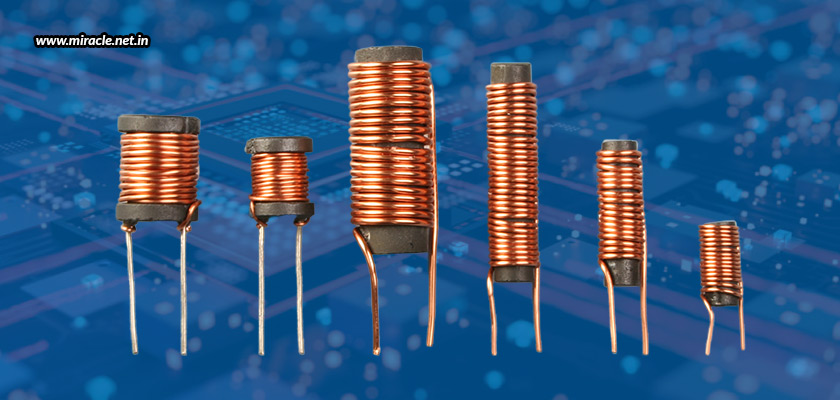

Air core inductors are simple but very important parts in modern electronics. They do not use a magnetic core, which helps reduce energy loss and improve performance at high frequencies. These inductors are widely used in RF circuits, wireless communication, 5G networks, satellite systems, and IoT devices. Because there is no core material, they avoid problems like core saturation and distortion, making them more stable and accurate. In high-frequency applications, air core inductors often perform better than ferrite-core inductors. Even though they are small and less noticed, they play a key role in ensuring smooth and reliable electronic performance in advanced technologies.
Understanding air core inductors
An air core inductor is a coil of wire that does not use a magnetic core like ferrite or iron. Instead, it uses air or another non-magnetic material as its core. When electric current flows through the coil, it creates a magnetic field in the surrounding air. Unlike core-based inductors, there is no material to strengthen or concentrate the magnetic field. This simple structure reduces energy loss and avoids issues like core saturation. Because of this, air core inductors perform very well in high-frequency applications, offering stable, accurate, and efficient operation in modern electronic circuits and communication systems.
Why high-frequency electronics demand special components
High-frequency systems – such as RF communication, radar, satellite links, and high-speed data transmission – operate in a completely different environment compared to low-frequency power electronics. At high frequencies, components must deal with:
- Signal distortion
- Skin effect losses
- Parasitic capacitance
- Electromagnetic interference
- Core saturation issues
In such conditions, even small inefficiencies can lead to significant signal degradation. This is where air core inductors stand out.
The air core advantage: No magnetic core, no saturation
One of the most important limitations of ferrite-core or iron-core inductors is magnetic saturation. When the magnetic core material reaches its limit, it can no longer increase magnetic flux proportionally with the current, which leads to distortion and reduced performance. Air core inductors completely eliminate this problem because they do not use any magnetic material. Since there is no magnetic core involved,
- There is no saturation point, even at higher currents
- The inductance remains highly linear across operating conditions
- Signal distortion is significantly reduced, ensuring cleaner output
- Performance stays stable over a wide frequency range
This makes air core inductors extremely reliable in applications where signal integrity, precision, and consistent high-frequency performance are critical in modern electronic and communication systems.
Superior performance at high frequencies
Ferrite cores are excellent at low to medium frequencies because they increase inductance significantly. However, as frequency increases, ferrite materials begin to show losses due to hysteresis loss, eddy current loss, and core heating. Air core inductors avoid all of these issues; at high frequencies,
- There are no core losses
- The Q factor (quality factor) remains high
- Energy loss is minimal
- Signal purity is preserved
This is why air core inductors are widely preferred in RF circuits and communication systems operating in the MHz to GHz range, where maintaining signal accuracy, low loss, and stable performance is essential for wireless technologies and high-speed data transmission.
High linearity
Linearity refers to how consistently an inductor behaves under varying current conditions. In communication systems, linearity is essential because even slight distortion can alter transmitted or received signals. Air core inductors provide:
- Highly linear inductance response
- Predictable electromagnetic behaviour
- Minimal harmonic distortion
This makes them especially valuable in audio frequency crossovers, RF amplifiers, and precision measurement systems where accurate signal reproduction is critical. Their stable performance ensures that signals remain clean and undistorted even under changing operating conditions, supporting high-quality output in both communication and audio applications across sensitive and high-precision electronic systems.
Role in RF circuits and communication systems
Air core inductors are widely used in RF circuits, which are the backbone of modern wireless communication systems such as mobile networks, Wi-Fi routers, Bluetooth devices, satellite communication systems, and radar systems.
- RF filters: In RF filters, inductors work alongside capacitors to allow or block specific frequency ranges. Air core inductors help maintain sharp frequency response without distortion.
- Tuned circuits: In oscillators and tuners, air core inductors ensure stable resonance frequencies due to their predictable inductance.
- Impedance matching networks: Efficient signal transfer between circuits requires impedance matching. Air core inductors help achieve this with minimal signal loss.
Design considerations of air core inductors
Designing air core inductors is both an art and a science. Engineers must carefully consider:
- Coil geometry: The shape of the coil directly affects inductance and field distribution.
- Wire spacing: Proper spacing reduces parasitic capacitance and improves high-frequency response.
- Wire thickness: Thicker wires reduce resistance but may increase size; optimization is key.
- Mechanical stability: Since there is no rigid core, physical stability is crucial to maintain consistent performance.
- Environmental shielding: Air core inductors are more susceptible to external electromagnetic interference, so shielding is often necessary.
Companies like Miracle Electronics, one of the leading air core inductor manufacturers in India, provide precision-engineered solutions that meet stringent requirements of RF and high-frequency communication systems, ensuring reliable and consistent performance across applications.
Why air core inductors are becoming more important
As electronics continue to move toward, the limitations of magnetic-core inductors like higher frequencies, smaller signal tolerances, increased wireless dependency, and faster data transmission are becoming more apparent. Air core inductors are gaining importance because they align perfectly with these trends:
- No saturation
- No magnetic losses
- High frequency stability
- Excellent linearity
In essence, they are future-ready components for next-generation electronics. Air core inductors may not be the most visible components in an electronic system, but they are among the most important in high-frequency applications. By removing magnetic core limitations, they offer excellent linearity, very low energy loss, and stable performance in RF and communication circuits. They avoid problems like saturation and signal distortion, making them highly reliable for precision applications. While ferrite-core inductors are still widely used in low-frequency and power systems, air core inductors quietly support the backbone of modern wireless communication. In today’s world of fast connectivity, they ensure clean, accurate, and efficient signal transmission without compromise.