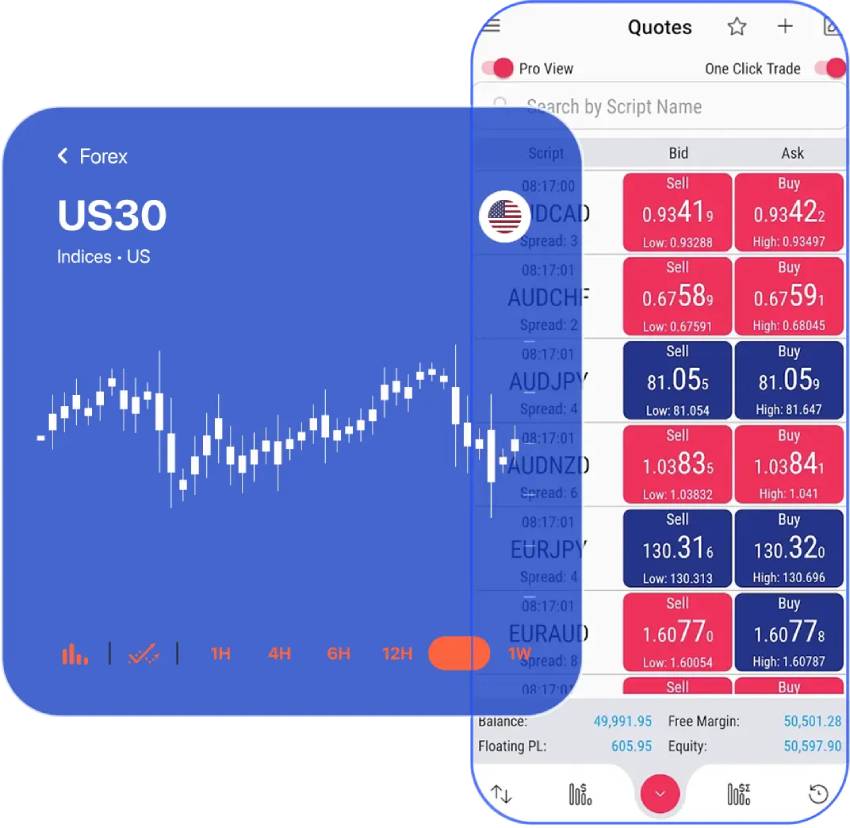

Tradex.live, the top equity trading platform in India offers diverse stock selection, real-time market insights, and risk management tools in one user-friendly application for success
What Is Equity Trading?
Equity trading is the buying and selling of shares (also called equities or stocks) of publicly listed companies on a stock exchange. When you purchase an equity share, you become a part-owner of that company — entitled to a proportional claim on its profits, assets, and voting rights at shareholder meetings.
In India, equity trading happens primarily on two recognised stock exchanges regulated by the Securities and Exchange Board of India (SEBI):
- National Stock Exchange (NSE) — home to the Nifty 50 index
- Bombay Stock Exchange (BSE) — home to the Sensex, Asia’s oldest stock exchange
Every legitimate equity trade in India is routed through these exchanges, settled through clearing corporations (NSCCL, ICCL), and held in your demat account with depositories (NSDL or CDSL). This regulated structure is what protects investors and distinguishes real equity trading from informal or off-exchange alternatives.
How Equity Trading Works in India
- You place an order through a SEBI-registered stockbroker’s platform (web, mobile app, or call-and-trade).
- The broker routes the order to the exchange (NSE or BSE).
- The exchange matches buyers and sellers based on price-time priority.
- The trade is confirmed instantly, and you receive a contract note by end of day.
- Settlement happens on T+1 basis — shares arrive in your demat account, and funds are debited, one working day after the trade.
To participate, you need three linked accounts: a trading account (to place orders), a demat account (to hold shares electronically), and a bank account (for fund transfers). Most brokers offer all three as a 3-in-1 bundle.
Types of Equity Trading
1. Delivery Trading
(Investment-Based Equity Trading) You buy shares and hold them in your demat account for days, months, or years. Ownership transfers fully to you.
2. Intraday Trading
You buy and sell the same stock within a single trading session (9:15 AM to 3:30 PM IST). Positions must be squared off before market close.
3. Swing Trading
Positions are held for several days to a few weeks to capture medium-term price swings. Swing traders rely heavily on technical analysis.
4. Positional Trading
A longer version of swing trading where positions are held for weeks to months, based on a specific market thesis or trend.
5. BTST
(Buy Today, Sell Tomorrow) You buy shares today and sell them the next day before they’re credited to your demat account.
6. Equity Derivatives
(Futures & Options) Contracts whose value derives from underlying equity shares or indices. Used for hedging and speculation.
Equity Trading vs. Other Asset Classes
| Asset Class | Returns Potential | Risk Level | Liquidity | Regulator | Notes |
|---|---|---|---|---|---|
| Equity Shares | High (long-term) | High | Very High | SEBI | Wealth creation |
| Mutual Funds | Moderate to High | Moderate | High | SEBI / AMFI | Diversified |
| Fixed Deposits | Low | Very Low | Moderate | RBI | Capital safety |
| Gold | Moderate | Moderate | High | — | Inflation hedge |
| Real Estate | Moderate to High | Moderate | Low | RERA | Long horizon |
| Bonds / Debt | Low to Moderate | Low | Moderate | SEBI / RBI | Income-oriented |
Equity historically delivers the highest long-term returns among traditional asset classes in India, but it also experiences the largest short-term volatility. Most financial advisors recommend equity as a core component of long-term portfolios, with allocation depending on age, goals, and risk tolerance.
Community
Join the TradeX community to avail the benefits!
Key Concepts Every Equity Trader Should Know
Bid and Ask Price — The bid is the highest price a buyer is willing to pay; the ask is the lowest price a seller will accept. The gap between them is the spread.
Market Order vs. Limit Order — A market order executes immediately at the best available price. A limit order executes only at your specified price or better.
Stop-Loss Order — An order that triggers an automatic sale if a stock falls to a predetermined price, helping cap losses.
Circuit Limits — Daily price bands (typically 5%, 10%, or 20%) beyond which a stock cannot move in a single session.
Volume — The number of shares traded in a given period. High volume confirms price movements.
Market Capitalisation — Share price multiplied by total outstanding shares (Large-cap, Mid-cap, Small-cap).
P/E Ratio — Price-to-Earnings ratio, comparing a company’s share price to its earnings per share.
Dividend — A portion of company profits distributed to shareholders.
How to Start Equity Trading in India: Step-by-Step
Choose a SEBI-registered stockbroker. Verify the broker’s SEBI registration number on the SEBI website before opening an account.
Open a demat and trading account. Submit PAN, Aadhaar, bank proof, and a signed agreement. Most accounts open within 24–48 hours via e-KYC.
Link your bank account. Fund transfers happen via UPI, IMPS, or NEFT.
Learn the platform. Practise with the broker’s paper trading or virtual trading feature before risking real capital.
Start small. Begin with a small portion of investable capital in well-known large-cap stocks while you build experience.
Build a strategy. Decide whether you’re investing for the long term, swing trading, or doing intraday — and stick to one approach.
Track, review, learn. Maintain a trade journal. Review wins and losses honestly. Markets reward discipline, not impulse.
Popular Equity Trading Strategies
Fundamental Analysis
Studying a company’s financial statements, management quality, industry position, and growth prospects to identify undervalued stocks. Used primarily by long-term investors. Key metrics: revenue growth, profit margins, ROE, debt-to-equity, and free cash flow.
Technical Analysis
Studying price charts, patterns, and indicators (RSI, MACD, moving averages, Bollinger Bands) to forecast short-term price movements. Used heavily by intraday and swing traders.
Value Investing
Popularised by Benjamin Graham and Warren Buffett — buying quality companies trading below their intrinsic value and holding for the long term.
Growth Investing
Focusing on companies with above-average earnings growth, even if they trade at premium valuations.
Momentum Trading
Buying stocks showing strong upward price action and selling when momentum fades.
Index Investing
Rather than picking individual stocks, investing in index funds or ETFs that mirror Nifty 50, Sensex, or sectoral indices — a low-cost, diversified approach.
Risks of Equity Trading
Equity trading offers attractive return potential but carries genuine risks that every participant must understand.
- Market Risk — Broad market declines affect almost all stocks regardless of company fundamentals.
- Company-Specific Risk — Poor earnings, fraud, management changes, or sectoral disruption.
- Liquidity Risk — Hard to exit some small-cap stocks at fair prices due to low volumes.
- Volatility Risk — Sharp and emotionally challenging short-term price swings.
- Leverage Risk — Using margin amplifies both gains and losses.
- Behavioural Risk — Fear, greed, and overconfidence cause more losses than market moves do.
Risk management isn’t optional. Position sizing, stop-losses, diversification across sectors, and not investing borrowed money are basic protections every trader should adopt.
Popular Equity Trading Strategies
Long-Term Capital Gains (LTCG) — Shares held over 12 months. Gains above ₹1.25 lakh per financial year are taxed at 12.5%.
Short-Term Capital Gains (STCG) — Shares held under 12 months. Taxed at 20%.
Intraday Trading — Treated as speculative business income, taxed at your applicable income tax slab rate.
F&O Trading — Treated as non-speculative business income, taxed at slab rate, with audit requirements above turnover thresholds.
(Rates reflect the Finance Act 2024 framework. Always confirm current rates with a chartered accountant.) Securities Transaction Tax (STT), exchange charges, GST, stamp duty, and brokerage are levied on every trade and reduce net returns.
Why Investor Protection Matters: Trading Only on Recognised Exchanges
Every legitimate equity trade in India happens on NSE or BSE, with shares held in a SEBI-regulated demat account. This structure provides:
- Investor Protection Fund coverage in case of broker default
- SEBI’s SCORES grievance redressal portal
- Clearing corporation guarantees on settlement
- Audit trails, contract notes, and tax documentation
- Insurance protection on demat holdings
Off-exchange or “informal” trading platforms — sometimes marketed as faster, cheaper, or tax-free — strip away every one of these protections. Operating or participating in such systems is a criminal offence under the Securities Contracts (Regulation) Act, 1956. SEBI maintains a public list of registered intermediaries; if a platform isn’t on it, it isn’t legitimate.
This is the single most important rule of equity trading in India: trade only through SEBI-registered brokers on recognised exchanges
Equity Trading vs. Other Asset Classes
| Asset Class | Returns Potential | Risk Level | Liquidity | Regulator | Notes |
|---|---|---|---|---|---|
| Equity Shares | High (long-term) | High | Very High | SEBI | Wealth creation |
| Mutual Funds | Moderate to High | Moderate | High | SEBI / AMFI | Diversified |
| Fixed Deposits | Low | Very Low | Moderate | RBI | Capital safety |
| Gold | Moderate | Moderate | High | — | Inflation hedge |
| Real Estate | Moderate to High | Moderate | Low | RERA | Long horizon |
| Bonds / Debt | Low to Moderate | Low | Moderate | SEBI / RBI | Income-oriented |
Equity historically delivers the highest long-term returns among traditional asset classes in India, but it also experiences the largest short-term volatility. Most financial advisors recommend equity as a core component of long-term portfolios, with allocation depending on age, goals, and risk tolerance.
Community
Join the TradeX community to avail the benefits!
Key Concepts Every Equity Trader Should Know
Bid and Ask Price — The bid is the highest price a buyer is willing to pay; the ask is the lowest price a seller will accept. The gap between them is the spread.
Market Order vs. Limit Order — A market order executes immediately at the best available price. A limit order executes only at your specified price or better.
Stop-Loss Order — An order that triggers an automatic sale if a stock falls to a predetermined price, helping cap losses.
Circuit Limits — Daily price bands (typically 5%, 10%, or 20%) beyond which a stock cannot move in a single session.
Volume — The number of shares traded in a given period. High volume confirms price movements.
Market Capitalisation — Share price multiplied by total outstanding shares (Large-cap, Mid-cap, Small-cap).
P/E Ratio — Price-to-Earnings ratio, comparing a company’s share price to its earnings per share.
Dividend — A portion of company profits distributed to shareholders.
How to Start Equity Trading in India: Step-by-Step
Choose a SEBI-registered stockbroker. Verify the broker’s SEBI registration number on the SEBI website before opening an account.
Open a demat and trading account. Submit PAN, Aadhaar, bank proof, and a signed agreement. Most accounts open within 24–48 hours via e-KYC.
Link your bank account. Fund transfers happen via UPI, IMPS, or NEFT.
Learn the platform. Practise with the broker’s paper trading or virtual trading feature before risking real capital.
Start small. Begin with a small portion of investable capital in well-known large-cap stocks while you build experience.
Build a strategy. Decide whether you’re investing for the long term, swing trading, or doing intraday — and stick to one approach.
Track, review, learn. Maintain a trade journal. Review wins and losses honestly. Markets reward discipline, not impulse.
Popular Equity Trading Strategies
Fundamental Analysis
Studying a company’s financial statements, management quality, industry position, and growth prospects to identify undervalued stocks. Used primarily by long-term investors. Key metrics: revenue growth, profit margins, ROE, debt-to-equity, and free cash flow.
Technical Analysis
Studying price charts, patterns, and indicators (RSI, MACD, moving averages, Bollinger Bands) to forecast short-term price movements. Used heavily by intraday and swing traders.
Value Investing
Popularised by Benjamin Graham and Warren Buffett — buying quality companies trading below their intrinsic value and holding for the long term.
Growth Investing
Focusing on companies with above-average earnings growth, even if they trade at premium valuations.
Momentum Trading
Buying stocks showing strong upward price action and selling when momentum fades.
Index Investing
Rather than picking individual stocks, investing in index funds or ETFs that mirror Nifty 50, Sensex, or sectoral indices — a low-cost, diversified approach.
Risks of Equity Trading
Equity trading offers attractive return potential but carries genuine risks that every participant must understand.
- Market Risk — Broad market declines affect almost all stocks regardless of company fundamentals.
- Company-Specific Risk — Poor earnings, fraud, management changes, or sectoral disruption.
- Liquidity Risk — Hard to exit some small-cap stocks at fair prices due to low volumes.
- Volatility Risk — Sharp and emotionally challenging short-term price swings.
- Leverage Risk — Using margin amplifies both gains and losses.
- Behavioural Risk — Fear, greed, and overconfidence cause more losses than market moves do.
Risk management isn’t optional. Position sizing, stop-losses, diversification across sectors, and not investing borrowed money are basic protections every trader should adopt.
Popular Equity Trading Strategies
Long-Term Capital Gains (LTCG) — Shares held over 12 months. Gains above ₹1.25 lakh per financial year are taxed at 12.5%.
Short-Term Capital Gains (STCG) — Shares held under 12 months. Taxed at 20%.
Intraday Trading — Treated as speculative business income, taxed at your applicable income tax slab rate.
F&O Trading — Treated as non-speculative business income, taxed at slab rate, with audit requirements above turnover thresholds.
(Rates reflect the Finance Act 2024 framework. Always confirm current rates with a chartered accountant.) Securities Transaction Tax (STT), exchange charges, GST, stamp duty, and brokerage are levied on every trade and reduce net returns.
Why Investor Protection Matters: Trading Only on Recognised Exchanges
Every legitimate equity trade in India happens on NSE or BSE, with shares held in a SEBI-regulated demat account. This structure provides:
- Investor Protection Fund coverage in case of broker default
- SEBI’s SCORES grievance redressal portal
- Clearing corporation guarantees on settlement
- Audit trails, contract notes, and tax documentation
- Insurance protection on demat holdings
Off-exchange or “informal” trading platforms — sometimes marketed as faster, cheaper, or tax-free — strip away every one of these protections. Operating or participating in such systems is a criminal offence under the Securities Contracts (Regulation) Act, 1956. SEBI maintains a public list of registered intermediaries; if a platform isn’t on it, it isn’t legitimate.
This is the single most important rule of equity trading in India: trade only through SEBI-registered brokers on recognised exchanges.
Equity Trading vs. Other Asset Classes
| Asset Class | Returns Potential | Risk Level | Liquidity | Regulator | Notes |
|---|---|---|---|---|---|
| Equity Shares | High (long-term) | High | Very High | SEBI | Wealth creation |
| Mutual Funds | Moderate to High | Moderate | High | SEBI / AMFI | Diversified |
| Fixed Deposits | Low | Very Low | Moderate | RBI | Capital safety |
| Gold | Moderate | Moderate | High | — | Inflation hedge |
| Real Estate | Moderate to High | Moderate | Low | RERA | Long horizon |
| Bonds / Debt | Low to Moderate | Low | Moderate | SEBI / RBI | Income-oriented |
Equity historically delivers the highest long-term returns among traditional asset classes in India, but it also experiences the largest short-term volatility. Most financial advisors recommend equity as a core component of long-term portfolios, with allocation depending on age, goals, and risk tolerance.
Community
Join the TradeX community to avail the benefits!
Key Concepts Every Equity Trader Should Know
Bid and Ask Price — The bid is the highest price a buyer is willing to pay; the ask is the lowest price a seller will accept. The gap between them is the spread.
Market Order vs. Limit Order — A market order executes immediately at the best available price. A limit order executes only at your specified price or better.
Stop-Loss Order — An order that triggers an automatic sale if a stock falls to a predetermined price, helping cap losses.
Circuit Limits — Daily price bands (typically 5%, 10%, or 20%) beyond which a stock cannot move in a single session.
Volume — The number of shares traded in a given period. High volume confirms price movements.
Market Capitalisation — Share price multiplied by total outstanding shares (Large-cap, Mid-cap, Small-cap).
P/E Ratio — Price-to-Earnings ratio, comparing a company’s share price to its earnings per share.
Dividend — A portion of company profits distributed to shareholders.
How to Start Equity Trading in India: Step-by-Step
Choose a SEBI-registered stockbroker. Verify the broker’s SEBI registration number on the SEBI website before opening an account.
Open a demat and trading account. Submit PAN, Aadhaar, bank proof, and a signed agreement. Most accounts open within 24–48 hours via e-KYC.
Link your bank account. Fund transfers happen via UPI, IMPS, or NEFT.
Learn the platform. Practise with the broker’s paper trading or virtual trading feature before risking real capital.
Start small. Begin with a small portion of investable capital in well-known large-cap stocks while you build experience.
Build a strategy. Decide whether you’re investing for the long term, swing trading, or doing intraday — and stick to one approach.
Track, review, learn. Maintain a trade journal. Review wins and losses honestly. Markets reward discipline, not impulse.
Popular Equity Trading Strategies
Fundamental Analysis
Studying a company’s financial statements, management quality, industry position, and growth prospects to identify undervalued stocks. Used primarily by long-term investors. Key metrics: revenue growth, profit margins, ROE, debt-to-equity, and free cash flow.
Technical Analysis
Studying price charts, patterns, and indicators (RSI, MACD, moving averages, Bollinger Bands) to forecast short-term price movements. Used heavily by intraday and swing traders.
Value Investing
Popularised by Benjamin Graham and Warren Buffett — buying quality companies trading below their intrinsic value and holding for the long term.
Growth Investing
Focusing on companies with above-average earnings growth, even if they trade at premium valuations.
Momentum Trading
Buying stocks showing strong upward price action and selling when momentum fades.
Index Investing
Rather than picking individual stocks, investing in index funds or ETFs that mirror Nifty 50, Sensex, or sectoral indices — a low-cost, diversified approach.
Risks of Equity Trading
Equity trading offers attractive return potential but carries genuine risks that every participant must understand.