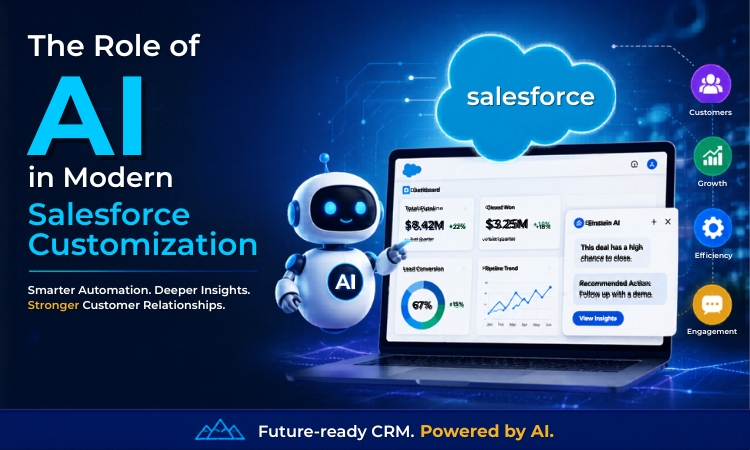

Businesses today operate in a rapidly shifting digital environment where customer expectations evolve almost daily. Traditional CRM systems are no longer sufficient for organizations that want to deliver hyper-personalized experiences, faster support, and intelligent decision-making. This is where salesforce customization combined with Artificial Intelligence becomes extraordinarily valuable.
Over the last few years, Salesforce has transformed from a simple customer management platform into a sophisticated ecosystem capable of handling automation, analytics, and intelligent customer engagement. AI is now the catalytic force behind this transformation. Companies are leveraging AI in Salesforce to streamline operations, personalize communication, and uncover hidden business insights.
Modern organizations are no longer looking for static CRM systems. They want adaptive platforms that learn continuously and improve performance autonomously. AI introduces this capability into Salesforce environments with remarkable precision.
Businesses across industries are increasingly investing in Salesforce customization services to create CRM systems tailored to their operational workflows. AI amplifies these customizations by making them smarter, faster, and more predictive.
What Is AI in Salesforce?
Artificial Intelligence in Salesforce refers to the use of machine learning, predictive analytics, natural language processing, and intelligent automation within the Salesforce ecosystem. These technologies help organizations analyze large datasets, automate tasks, and improve customer experiences without constant manual intervention.
Salesforce has integrated AI functionalities into multiple areas of its platform. From intelligent lead scoring to predictive recommendations, AI helps businesses make data-driven decisions with greater confidence.
The primary objective of AI in Salesforce is not merely automation. Its deeper purpose is augmentation. It enhances human capabilities rather than replacing them entirely.
For example, AI can analyze customer interactions and recommend the next best action for sales representatives. It can identify purchasing patterns, predict churn risks, and even automate customer support responses. These capabilities drastically improve operational efficiency.
The rise of intelligent CRM systems has also reshaped the landscape of salesforce development. Developers now create custom solutions that integrate AI algorithms directly into workflows, dashboards, and customer service processes.
How AI Improves Salesforce Customization
Personalized Workflows and Automation
One of the most transformative aspects of AI is workflow automation. Traditional CRM customization required businesses to manually configure processes and update them regularly. AI changes this dynamic completely.
AI-driven systems can automatically optimize workflows based on user behavior and historical data. This creates a more adaptive CRM environment that evolves continuously.
For instance, automated lead assignment systems can evaluate customer intent, geographic location, and interaction history before routing leads to the most suitable sales representatives. This minimizes delays and improves conversion rates.
Businesses using salesforce custom development often integrate AI-powered automation tools to reduce repetitive tasks and enhance employee productivity.
Predictive Analytics for Smarter Decisions
Predictive analytics is another compelling advantage. AI can process colossal amounts of customer data and forecast future outcomes with impressive accuracy.
Sales teams can identify which prospects are most likely to convert. Customer support teams can predict escalation risks. Marketing departments can anticipate campaign performance before launch.
These predictive insights help organizations allocate resources more intelligently and reduce operational uncertainty.
AI-Powered Dashboards and Reporting
Traditional reports are static and reactive. AI-powered dashboards are dynamic and predictive.
Modern Salesforce dashboards can now provide intelligent recommendations, identify anomalies, and generate real-time insights. Decision-makers gain immediate visibility into operational trends without manually analyzing endless spreadsheets.
This dramatically improves strategic planning and business agility.
Benefits of AI in Salesforce CRM
Better Customer Engagement
AI enables businesses to deliver highly personalized customer experiences. It analyzes browsing behavior, communication preferences, purchase history, and engagement patterns to tailor interactions more effectively.
Customers increasingly expect personalized communication. Generic interactions often feel impersonal and outdated. AI helps organizations create nuanced customer journeys that feel intuitive and human-centric.
Enhanced Operational Efficiency
Manual administrative work consumes enormous amounts of time. AI reduces this burden significantly.
Tasks such as data entry, email categorization, lead qualification, and workflow management can be automated efficiently. Employees can focus on strategic activities instead of repetitive operational tasks.
This efficiency boost is one of the major Benefits of AI in Salesforce CRM for growing enterprises.
Improved Sales Forecasting and Productivity
Sales forecasting traditionally relied on intuition and fragmented data analysis. AI introduces greater precision into forecasting models.
By analyzing customer behavior patterns and market trends, AI can estimate future sales opportunities more accurately. This helps businesses make informed financial and operational decisions.
Sales representatives also benefit from intelligent recommendations that prioritize high-value opportunities.
Reduced Manual Errors and Repetitive Tasks
Human error remains a persistent challenge in CRM management. AI minimizes inaccuracies through automation and intelligent validation systems.
Duplicate records, incomplete data entries, and workflow inconsistencies can be detected automatically. This ensures cleaner data management and better operational continuity.
The Connection Between Salesforce Development and AI
The integration of AI into CRM systems has significantly influenced modern salesforce development practices. Developers are now building intelligent systems instead of merely functional systems.
AI-driven development involves creating dynamic workflows, predictive models, conversational interfaces, and automated recommendation engines directly within Salesforce environments.
Custom applications can now analyze customer behavior in real time and trigger automated responses instantly. This level of intelligence was difficult to achieve using conventional CRM customization approaches.
Developers also play a crucial role in integrating third-party AI tools into Salesforce platforms. These integrations allow businesses to unify analytics, automation, and customer engagement strategies under one centralized ecosystem.
Organizations seeking long-term digital scalability increasingly rely on advanced salesforce consulting services to implement these intelligent solutions effectively.
AI-Powered Salesforce Customization Services
Modern Salesforce customization services are evolving rapidly because of AI integration. Businesses no longer want isolated CRM functionalities. They want intelligent systems capable of learning and adapting.
Automation-Focused Customization
AI-powered automation allows businesses to simplify complex processes. From invoice approvals to customer onboarding, workflows become significantly more efficient.
Automation also improves consistency across departments, reducing operational fragmentation.
AI-Enabled Customer Service Solutions
Customer support has become one of the most impactful areas for AI adoption.
AI-powered chatbots, virtual assistants, and intelligent ticket routing systems help businesses respond faster and more accurately. Support teams gain immediate access to contextual customer information, improving issue resolution speed.
Intelligent Lead Management Systems
Lead management becomes remarkably more efficient with AI.
Instead of treating every prospect equally, AI evaluates lead quality based on behavioral data, engagement metrics, and historical conversion patterns. This enables businesses to focus on high-potential opportunities.
Role of Salesforce Integration Consulting in AI Adoption
AI adoption within Salesforce environments often requires sophisticated integration strategies. This is where salesforce integration consulting becomes highly valuable.
Businesses frequently operate multiple platforms simultaneously, including ERP systems, marketing automation tools, customer support platforms, and analytics software. AI functions optimally when these systems communicate seamlessly.
Integration consulting helps organizations create unified ecosystems where data flows continuously across platforms. This improves visibility, enhances reporting accuracy, and enables more intelligent automation.
Well-executed integrations also reduce data silos, which are one of the biggest obstacles to effective AI implementation.
Challenges Businesses Face While Implementing AI in Salesforce
Data Quality and Governance
AI systems depend heavily on accurate data. Poor-quality information leads to unreliable predictions and ineffective automation.
Organizations must establish strong data governance practices before implementing AI-driven Salesforce customization.
Complexity in Implementation
AI implementation can be technically intricate. Businesses often underestimate the architectural complexity involved in integrating machine learning models with CRM systems.
This is why partnering with experienced professionals becomes essential.
User Adoption and Training Issues
Technology adoption is not solely a technical challenge. It is also a human challenge.
Employees may resist AI-powered systems due to unfamiliarity or fear of automation. Proper training and change management strategies are crucial for successful implementation.
Choosing the Right Salesforce Implementation Partner
Selecting the right salesforce implementation partner plays a pivotal role in AI success.
Businesses should look for partners with strong technical expertise, integration capabilities, and strategic understanding of CRM transformation. A competent implementation partner can design scalable architectures that accommodate future AI innovations.
Companies like CloudMetic contribute to this evolving ecosystem by helping businesses navigate modern Salesforce transformation strategies through customization, integration, and intelligent CRM solutions.
A future-ready implementation strategy should prioritize flexibility, security, scalability, and continuous optimization.
Future of AI in Salesforce Customization
The future of salesforce customization will be increasingly autonomous, predictive, and personalized.
AI will continue evolving from supportive automation into proactive business intelligence. CRM systems will eventually anticipate customer needs before direct interactions even occur.
Hyper-personalization will become standard practice. Businesses will use AI to deliver individualized experiences at unprecedented scale.
Voice-enabled CRM interactions, autonomous workflows, predictive customer retention strategies, and intelligent recommendation systems are expected to become more mainstream in the coming years.
Organizations that embrace AI-driven Salesforce transformation early will likely gain stronger competitive advantages in customer engagement, operational efficiency, and decision-making agility.
Conclusion
AI is fundamentally reshaping how businesses approach CRM customization. Modern organizations no longer view Salesforce as merely a customer database. It has evolved into an intelligent operational nucleus capable of driving automation, analytics, and personalized customer experiences.
The combination of AI and salesforce customization enables businesses to create smarter workflows, improve productivity, and enhance customer engagement with remarkable precision. From predictive analytics to intelligent automation, AI introduces a new dimension of capability into CRM ecosystems.
As businesses continue investing in digital transformation, the demand for advanced salesforce consulting services, AI-driven customization, and intelligent integrations will continue expanding. Organizations that strategically adopt these innovations today will be better positioned for long-term growth and operational excellence tomorrow.