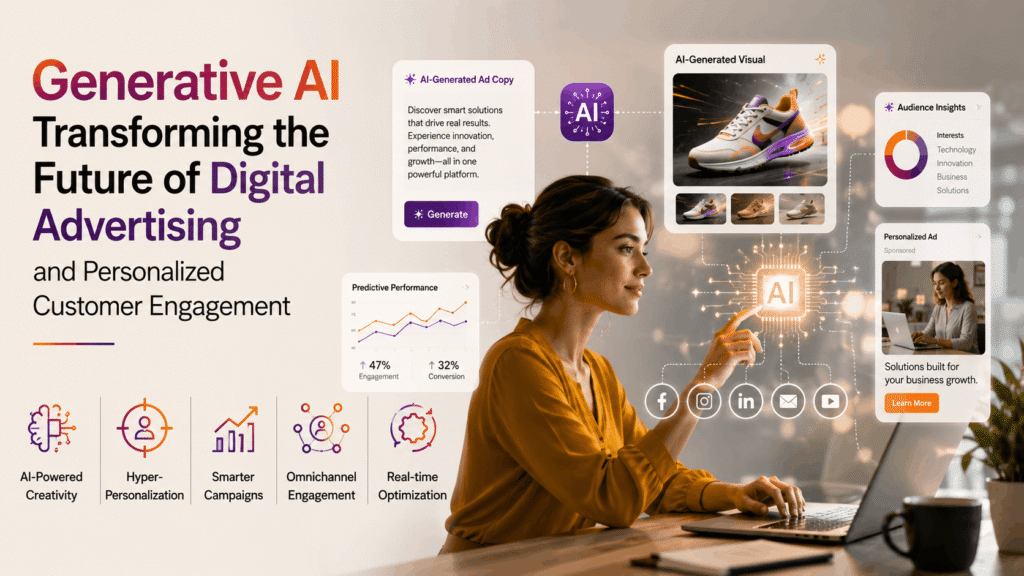

Digital advertising has always evolved alongside technology. From banner ads and search engine marketing to programmatic campaigns and social media targeting, every major technological shift has redefined how brands connect with audiences. Today, generative AI is emerging as the next major transformation, changing not only how advertisements are created but also how they are personalized, distributed, optimized, and experienced by consumers.
Unlike traditional automation tools, generative AI introduces a new level of intelligence into advertising ecosystems. It can create content, analyze customer behavior, generate audience insights, automate campaign development, and even simulate personalized brand conversations at scale. As enterprises increasingly integrate AI into marketing operations, digital advertising is moving toward a future defined by real-time personalization, conversational engagement, and predictive decision-making.
One of the most visible impacts of generative AI is in content creation. Advertising has historically depended on creative teams to produce campaign copy, visuals, video scripts, product descriptions, and promotional messaging. While creativity remains essential, AI-powered systems are dramatically accelerating production cycles. Brands can now generate multiple ad variations within minutes, test messaging across audience segments, and optimize campaigns far more efficiently than before.
This shift is especially important in an era where consumers expect highly personalized experiences. Generic advertisements are becoming less effective as audiences increasingly respond to content that feels contextual and relevant to their interests. Generative AI enables marketers to tailor ad copy, visuals, and recommendations dynamically based on user behavior, demographics, engagement patterns, and purchasing intent.
For example, a single advertising campaign can now automatically produce multiple versions of creative assets designed for different industries, job roles, geographic regions, or customer preferences. Instead of building static campaigns for broad audiences, enterprises can create adaptive advertising experiences that evolve in real time.
The rise of AI-driven personalization is also changing customer expectations. Consumers are becoming accustomed to intelligent interactions that anticipate needs and provide relevant recommendations instantly. This trend is pushing digital advertising beyond traditional display formats and toward conversational engagement models powered by AI assistants, chatbots, and interactive content systems.
Conversational advertising is rapidly emerging as a major opportunity within the digital ecosystem. Rather than simply clicking on ads, users are increasingly interacting with AI-powered platforms that answer questions, recommend products, and guide purchasing decisions. This creates a fundamentally different advertising environment where brands compete not only for visibility but also for contextual relevance inside AI-generated conversations.
Predictive analytics powered by generative AI is becoming especially valuable for enterprise marketers. AI models can forecast customer behavior, identify emerging demand trends, and recommend optimized campaign strategies before performance issues occur. This allows organizations to move from reactive advertising approaches to proactive engagement strategies.
Another significant change is occurring in video advertising. AI-generated video tools are reducing the cost and complexity of producing high-quality promotional content. Enterprises can now generate short-form videos, multilingual voiceovers, animated explainers, and dynamic product showcases without requiring extensive production resources. As video continues to dominate digital engagement across platforms, generative AI is helping brands scale visual storytelling faster and more cost-effectively.
However, the growing use of AI in advertising also introduces new challenges. Questions around transparency, authenticity, and trust are becoming increasingly important. Consumers are becoming more aware of AI-generated content and may react negatively if advertising feels manipulative, misleading, or overly automated. As a result, brands must balance efficiency with authenticity.
Trust is likely to become one of the most important competitive differentiators in the AI-driven advertising era. Organizations that use AI responsibly, disclose automated interactions clearly, and maintain high-quality content standards will likely build stronger long-term relationships with audiences. Ethical AI governance is therefore becoming a strategic priority for marketing leaders.
Privacy concerns are also reshaping how generative AI is deployed in advertising environments. Regulatory frameworks such as GDPR and other global data protection laws are limiting how companies collect and use consumer data. This is encouraging a transition toward first-party and consent-based data strategies. AI systems are increasingly being designed to operate within privacy-first frameworks that prioritize transparency and user control.
At the same time, generative AI is transforming account-based marketing and B2B advertising strategies. Enterprise marketers can now create highly customized outreach campaigns for specific industries, organizations, or executive personas at scale. AI-generated personalization allows brands to align messaging more closely with business priorities, improving engagement quality and conversion rates.
Looking ahead, digital advertising will become increasingly intelligent, conversational, and adaptive. AI systems will continue improving their ability to understand customer intent, generate contextual experiences, and optimize engagement across multiple channels simultaneously. Advertising may eventually evolve into a seamless layer of personalized recommendations embedded naturally within digital interactions rather than existing as isolated promotional content.
For enterprises, this transformation represents both an opportunity and a challenge. Organizations that embrace generative AI strategically can accelerate campaign performance, improve personalization, and gain deeper audience insights. Those that fail to adapt may struggle to remain visible in an increasingly AI-driven discovery ecosystem.
Ultimately, generative AI is reshaping digital advertising from a model focused primarily on exposure and targeting into one centered on intelligence, relevance, and engagement. The future of advertising will not simply be about reaching audiences — it will be about understanding them in more meaningful, contextual, and dynamic ways than ever before.
Read More: https://intentamplify.com/blog/marketing-on-chatgpt-exploring-the-future-of-ai-driven-advertising/