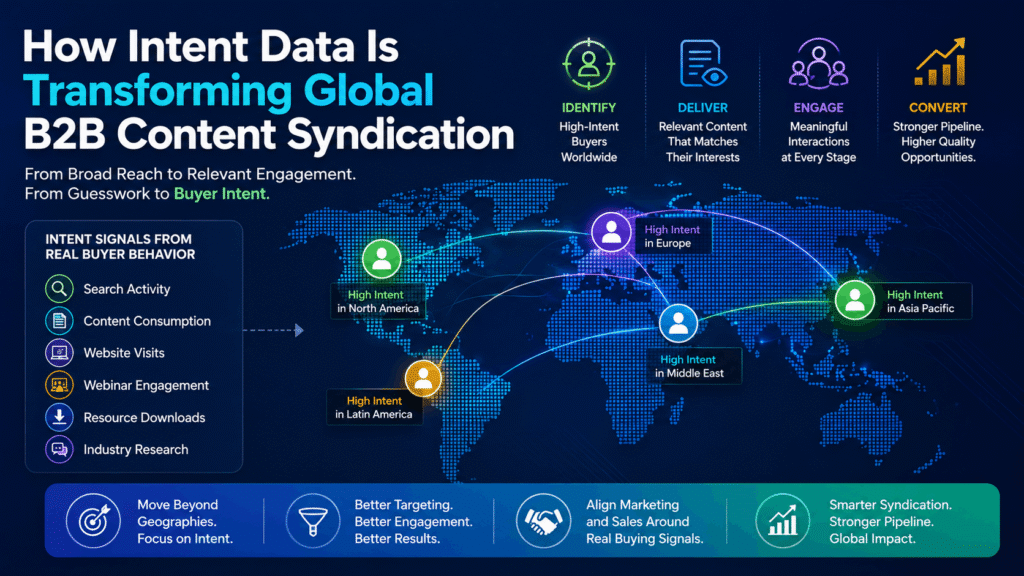

Global B2B marketing has changed dramatically over the last few years. Traditional lead generation models that relied heavily on broad targeting, static buyer personas, and geographic segmentation are becoming less effective in today’s competitive digital landscape. Modern buyers are more informed, self-directed, and selective about the content they engage with. As a result, B2B brands are increasingly shifting toward intent-driven strategies that prioritize buyer behavior over simple demographic or regional assumptions.
At the center of this transformation is intent data.
Intent data is reshaping how global B2B organizations approach content syndication by helping marketers identify, engage, and nurture prospects based on actual buying signals rather than guesswork. Instead of distributing content broadly and hoping the right audiences respond, brands can now align syndication efforts with accounts actively researching relevant solutions.
This shift is making global content syndication smarter, more targeted, and significantly more effective.
Understanding Intent Data in B2B Marketing
Intent data refers to behavioral signals that indicate a company or individual may be researching products, services, or topics related to a purchasing decision. These signals can come from:
- Content consumption patterns
- Search activity
- Website visits
- Webinar engagement
- Download behavior
- Industry research activity
- Third-party publisher interactions
In B2B marketing, intent data helps organizations understand where buyers are in their decision-making journey.
For example, if multiple employees from a company are researching cloud security frameworks, downloading cybersecurity reports, and attending compliance webinars, those activities suggest increasing purchase intent around security solutions.
Rather than targeting audiences based solely on industry or geography, marketers can focus on buyers already showing active interest.
The Evolution of Content Syndication
Traditional content syndication focused primarily on distribution volume. Brands published whitepapers, ebooks, reports, and webinars across publisher networks to maximize exposure and collect leads.
While this approach generated large lead databases, it often suffered from several issues:
- Low lead quality
- Weak buying intent
- Poor conversion rates
- Limited personalization
- Geographic over-targeting
In many cases, marketers prioritized reach over relevance.
Intent-driven content syndication changes this model entirely. Instead of asking, “Where can we distribute content?” marketers now ask, “Who is actively researching topics related to our solutions?”
This creates a more strategic and performance-oriented approach to syndication.
Why Geography Is Becoming Less Important
Historically, global B2B campaigns were heavily structured around regions, countries, and territories. Marketing teams created separate campaigns for North America, Europe, APAC, or the Middle East based largely on location.
While localization still matters, intent data is reducing the dominance of geography as the primary targeting factor.
Today, a cybersecurity buyer in Singapore may demonstrate stronger purchase readiness than a randomly selected prospect in a company’s priority market. Intent signals help marketers identify actual demand regardless of location.
This shift is particularly important in digital-first industries where:
- Buying journeys happen online
- Research behavior crosses borders
- Enterprise teams operate globally
- Decision-making involves distributed stakeholders
Intent data allows marketers to focus on readiness and relevance rather than relying solely on regional assumptions.
Higher Lead Quality Through Intent-Driven Targeting
One of the biggest benefits of intent-based syndication is improved lead quality.
Traditional syndication often produced large numbers of leads that matched firmographic criteria but lacked genuine buying interest. Sales teams then spent significant time filtering unqualified prospects.
Intent-driven campaigns improve this process by prioritizing audiences already demonstrating engagement signals.
For example, a SaaS company promoting a cloud automation report can target:
- Accounts actively researching cloud migration
- IT leaders consuming related technical content
- Companies engaging with competitor topics
- Prospects showing increased search activity around automation tools
This significantly increases the likelihood that syndicated leads are further along in the buying cycle.
The result is:
- Better sales alignment
- Higher conversion rates
- Faster pipeline acceleration
- Improved ROI from content investments
Personalization at Global Scale
Intent data also enables deeper personalization across international campaigns.
In traditional global syndication models, the same content was often distributed broadly across multiple markets with limited customization. This created generic experiences that failed to resonate with buyers.
Intent-based strategies allow marketers to tailor:
- Content recommendations
- Messaging themes
- Outreach timing
- Industry focus
- Buyer-stage engagement
For instance:
- Early-stage researchers may receive educational content
- Mid-funnel buyers may receive case studies or comparison reports
- High-intent accounts may receive demo invitations or analyst content
This personalization improves engagement because audiences receive content aligned with their current interests and research behavior.
The Role of AI and Predictive Analytics
Artificial intelligence is accelerating the impact of intent data in content syndication.
Modern B2B marketing platforms now use AI to:
- Analyze buyer behavior patterns
- Predict purchase likelihood
- Score intent signals
- Recommend next-best actions
- Optimize campaign timing
AI-powered intent analysis helps marketers identify not just who is researching, but when engagement is increasing and how likely accounts are to convert.
This allows global marketing teams to act more proactively rather than reactively.
For enterprise organizations managing large international campaigns, predictive intent models are becoming essential for prioritizing high-value accounts efficiently.
Aligning Marketing and Sales Around Intent
Intent data also improves collaboration between marketing and sales teams.
One of the longstanding challenges in B2B marketing has been the disconnect between lead generation and revenue generation. Marketing teams often focused on lead quantity, while sales teams focused on lead quality.
Intent-based syndication creates a shared framework centered around buying readiness.
When sales teams receive leads backed by verified engagement signals, conversations become more relevant and timely. Instead of cold outreach, sales representatives can engage prospects already researching specific challenges or technologies.
This alignment improves:
- Sales efficiency
- Pipeline predictability
- Account prioritization
- Conversion performance
Challenges of Intent-Driven Syndication
Despite its advantages, intent-driven syndication is not without challenges.
Key concerns include:
- Data accuracy and quality
- Privacy regulations across regions
- Overreliance on third-party data providers
- Signal interpretation complexity
- Integration across marketing platforms
Not every intent signal indicates immediate purchase readiness. Marketers still need strong qualification processes and contextual analysis.
Additionally, global compliance requirements such as GDPR and regional data privacy regulations continue shaping how intent data is collected and used.
Successful organizations balance personalization with responsible data practices.
The Future of Global B2B Content Syndication
The future of B2B content syndication is moving toward intelligent engagement rather than mass distribution.
As buyers become more selective and digital research behavior continues expanding, intent data will play an even larger role in helping marketers:
- Identify active demand
- Personalize global campaigns
- Improve lead quality
- Accelerate revenue opportunities
- Optimize content investment performance
The companies that succeed will not necessarily be the ones distributing the most content. They will be the ones delivering the right content to the right buyers at the right moment.
Final Thoughts
Intent data is fundamentally reshaping global B2B content syndication by shifting the focus from geographic reach to behavioral relevance.
Rather than relying solely on broad targeting models, modern marketers can now identify high-intent audiences based on real research activity and engagement patterns. This creates more efficient campaigns, stronger lead quality, better personalization, and improved alignment between marketing and sales.
In a global digital economy where buyers control more of the purchasing journey, intent-driven syndication is becoming a critical competitive advantage.
The future of B2B engagement is no longer about reaching everyone everywhere—it is about reaching the right buyers when their intent matters most.
Read More: https://intentamplify.com/blog/content-syndication-strategies-global-b2b-brands/