
I want to tell you about the period in my relationship that I do not talk about often.
Suhail Khan and Riya had been together for three years when things started feeling heavy.
Not broken. Not dramatic. Not the kind of heavy that ends in a conversation at two in the morning where someone says something they cannot take back. Just — heavy. The specific, quiet heaviness that arrives in a relationship when two people have been through enough together that they have forgotten to be light with each other. When the comfort becomes so deep that it starts to feel like distance. When you stop being the person who makes each other laugh and start being the people who manage each other’s schedules and split the grocery bill and ask about each other’s day in the tone of someone completing a checklist rather than someone who actually wants to know.
We were fine. That was the problem. Fine is a very boring thing to be with someone you are genuinely in love with.
I had been noticing it for about four months. The way our evenings had become practical — dinner, some television, phones, sleep. The way our conversations had become about things rather than about nothing, which sounds like an improvement but is actually the opposite. The way I could not remember the last time either of us had laughed properly — the unguarded kind, the kind that takes over before you can compose yourself.
I did not know what to do about it. You cannot schedule spontaneity. You cannot instruct someone to be light. And I did not want to have a conversation about the fact that we had stopped having fun, because that conversation felt like exactly the kind of serious, heavy thing that was the problem in the first place.
I wanted to do something small. Something that reminded her — reminded both of us — of who we were before the comfort became weight.
The Problem With Every Obvious Option
I spent nearly three weeks thinking about what that something could be.
A surprise trip — good idea in theory, but trips require planning and planning is exactly the kind of practical heaviness I was trying to interrupt. A fancy dinner — we had done that recently for her birthday and it was lovely and somehow still felt like the checklist. Flowers — too generic, says nothing specific about us.
I wanted something that looked at us specifically. At our faces. At the particular dynamic that had gotten buried under three years of logistics and responsibility. Something that found the funny in us rather than the formal.
I was thinking about this on a Tuesday evening — sitting at my desk, not really working, doing the unfocused scrolling that happens when your brain is working on something it has not solved yet — when I came across a couple caricature frame on a gifting site.
An illustrated portrait. Two faces, exaggerated in exactly the right ways. Warm and funny and specific in a way that a photograph is not — because photographs capture what you look like and caricatures capture something closer to who you are.
I stopped scrolling.
I thought about Riya’s nose — the specific way it scrunches when she finds something genuinely funny, which is different from when she is being polite about something. I thought about my own face, which she has described on multiple occasions as looking permanently slightly confused, which is accurate. I thought about what a caricature of the two of us would look like — whether it would make her laugh in the old way, the unguarded way.
I thought it might.
Finding the Right Place
I started looking for where to order a couple caricature in India that was actually good — not the mass-produced kind where everyone’s face looks vaguely the same regardless of who the photograph is of, but something that genuinely captured the specific people in the image.
I found Zingy Gifts and what immediately caught my attention was how personal the process felt. It was not simply upload a photograph and receive a product. They asked about the occasion, the style preference, whether I wanted a background, what I wanted written below the illustration. It felt like someone was actually paying attention to what I needed rather than processing an order.
I sent them the photograph I had in mind — not a posed one, not a special occasion one. A completely ordinary Saturday afternoon photograph from about eight months ago, both of us on the sofa, Riya mid-laugh at something I had said, me looking pleased with myself in the way I look when I think I have been funny. Both of us completely off-guard. Both of us looking exactly like ourselves in the best possible way.
That was the photograph. The one from before the heavy arrived.
Within a day they sent me a preview.
The Preview That Confirmed Everything
I was not expecting it to be as accurate as it was.
The nose scrunch was there. The pleased-with-myself expression was there — slightly exaggerated, which made it funnier and somehow more truthful rather than less. The warmth of the original photograph was in the illustration but amplified, the way caricatures amplify what is already present rather than inventing something new.
I sat at my desk at eleven at night and laughed alone in my flat.
Not a small laugh. A proper one. The unguarded kind.
I approved it immediately. No changes. It was exactly right.
The frame arrived five days later. The packaging was careful — bubble wrap, a solid cardboard sleeve, handled properly, no damage anywhere. The print quality was sharp. The frame was solid. It looked exactly like the preview, which matters more than it sounds because I have ordered personalised gifts in India before that arrived looking nothing like what was promised. This was not one of those experiences.
I kept it in my cupboard for four days, waiting for the right moment.
The Evening I Gave It to Her
I did not make an occasion of it. That was intentional.
No dinner reservation. No elaborate setup. A regular Thursday evening — she came over after work, we made chai, we were sitting at the kitchen table in exactly the kind of ordinary evening that had been feeling heavy for four months.
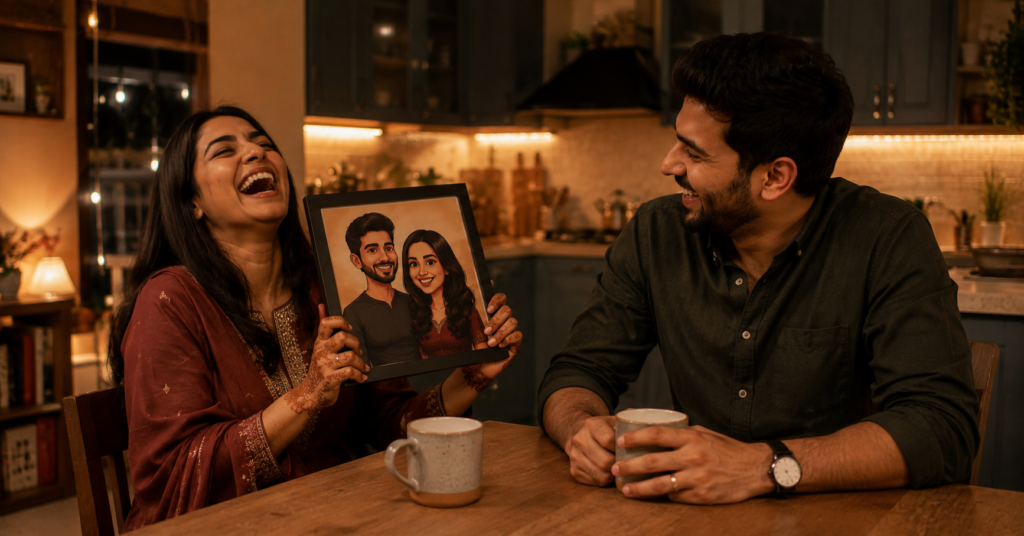
I got up, got the frame from the cupboard, and put it on the table in front of her. No speech. No explanation. Just the frame.
She looked at it for about three seconds before she started laughing.
The proper kind. The unguarded kind. The nose-scrunch kind that the caricature had somehow captured perfectly — and she was now demonstrating in real time, which made the whole thing better.
She picked it up. Looked at my illustrated expression. Said — why do you look so unbearably smug.
I said — that is just my face.
She said — this is exactly your face.
We sat at that kitchen table for forty minutes after that, not talking about anything serious, not managing anything, not completing any checklist. Just laughing about the caricature and about ourselves and about the specific ways we apparently look to each other.
It was the best Thursday evening we had had in four months.
What Changed After That
The frame is on the wall in her flat now. Her room, not the living room — the specific place where she put it tells me something about what it means to her.
Something shifted after that Thursday. Not dramatically, not with any announcement. Just a small recalibration — a reminder that we were also the people in that Saturday afternoon photograph, laughing on the sofa, before the comfortable heaviness arrived.
We have had more unguarded evenings since then. More talking about nothing in particular. More of the lightness.
I do not think the caricature fixed anything. I think it reminded us of something we had temporarily misplaced. Which is a different and more useful thing.
What I Would Tell Anyone in the Same Place
If your relationship has gotten heavy in the specific quiet way that does not announce itself as a problem — if you have been fine for long enough that fine has started to feel insufficient — try finding something that looks at both of you and finds the funny.
Not a grand gesture. Not a trip or a dinner that puts pressure on the evening. Something that sits on a wall and reminds you, every day, of who you are when you are being light with each other.
A couple caricature does this better than anything else I have tried. It is personal enough to be meaningful and funny enough to be disarming. It does not ask you to be serious about your feelings. It just shows you your own faces in the best possible way and lets the rest follow.
The best Thursday evening in four months cost less than most restaurant dinners and is now on her wall permanently.
That seems like a reasonable outcome to me.
Written by Suhail Khan, who discovered that sometimes the heaviness in a relationship does not need a serious conversation — it just needs something that makes both of you laugh about your own faces.