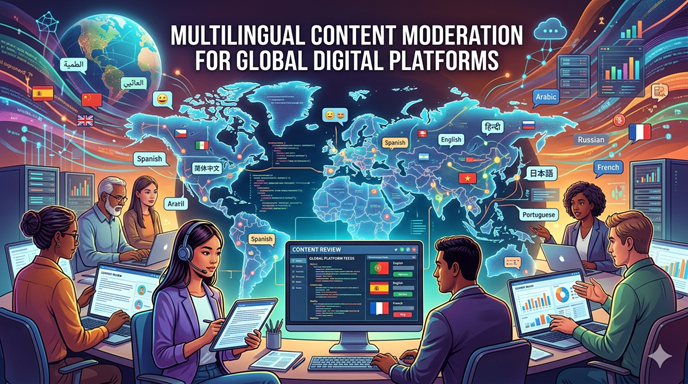

As digital platforms continue expanding across borders, multilingual communication has become central to online interactions. Social media networks, gaming communities, e-commerce marketplaces, forums, and streaming platforms now serve users speaking hundreds of languages and dialects. While this global connectivity creates enormous opportunities, it also introduces serious moderation challenges. Harmful content, hate speech, misinformation, harassment, and policy violations appear in multiple languages, often shaped by cultural context and regional nuances.
For global platforms, moderating English-only content is no longer sufficient. Businesses must implement multilingual content moderation systems capable of detecting unsafe or inappropriate material across diverse linguistic environments. This growing demand has increased the importance of partnering with a reliable Annotera and leveraging scalable data annotation outsourcing strategies to improve moderation accuracy worldwide.
Why Multilingual Content Moderation Matters
Global digital platforms operate in highly dynamic environments where users generate massive volumes of content every second. A single platform may receive posts, comments, videos, reviews, and messages in dozens of languages simultaneously. Without multilingual moderation capabilities, harmful content can easily bypass detection systems.
Content moderation failures can lead to:
- Brand reputation damage
- Legal and regulatory penalties
- User safety concerns
- Increased misinformation spread
- Community trust erosion
For example, hate speech or abusive slang in regional languages may remain undetected if moderation systems are trained primarily on English datasets. Similarly, sarcasm, coded language, or culturally specific insults can confuse automated moderation tools.
This is where high-quality annotation becomes essential. A professional text annotation company helps train AI moderation systems using linguistically diverse and context-rich datasets, enabling platforms to identify problematic content more effectively across regions.
The Complexity of Multilingual Moderation
Moderating multilingual content is far more complex than simple translation. Language is deeply tied to culture, context, and social behavior. Words that appear harmless in one language may be offensive in another. Additionally, many users intentionally manipulate spelling, slang, or symbols to evade moderation systems.
Some major challenges include:
1. Regional Dialects and Variations
Languages often vary significantly by geography. Spanish spoken in Mexico differs from Spanish used in Spain. Bengali slang in Kolkata may differ from usage in Bangladesh. AI models trained on standardized language datasets may fail to understand these regional nuances.
2. Low-Resource Languages
Many global platforms struggle with moderation for low-resource languages because insufficient labeled datasets exist. AI systems require large volumes of annotated data to accurately identify harmful patterns.
3. Code-Switching
Users frequently mix multiple languages within a single sentence. This practice, known as code-switching, creates difficulties for automated moderation models. For instance, users may combine Hindi and English or Arabic and French within one comment.
4. Contextual Meaning
Words often carry different meanings depending on cultural or conversational context. Literal translation alone cannot accurately determine intent, sarcasm, or implied hostility.
5. Evolving Online Slang
Internet language evolves rapidly. New abbreviations, memes, coded insults, and community-specific terminology emerge continuously, requiring moderation systems to adapt quickly.
To address these challenges, platforms increasingly rely on data annotation outsourcing partners capable of delivering multilingual datasets with cultural accuracy and domain expertise.
The Role of AI in Multilingual Content Moderation
Artificial intelligence has become a core component of modern moderation systems. Machine learning models can automatically analyze text, images, audio, and video content at scale. However, AI moderation systems are only as effective as the data used to train them.
AI moderation workflows typically involve:
- Toxicity detection
- Hate speech classification
- Spam identification
- Misinformation detection
- Sentiment analysis
- Keyword and phrase recognition
- Contextual content evaluation
To function effectively across languages, these systems require carefully labeled multilingual datasets. A trusted data annotation company provides human-annotated training data that improves the accuracy of AI models in recognizing harmful content patterns globally.
Why Human Annotation Remains Essential
Although AI moderation tools offer scalability, human expertise remains critical for multilingual moderation success. Human annotators understand cultural references, regional slang, sarcasm, and contextual meaning that automated systems often miss.
Human moderators and annotation teams help by:
- Labeling toxic or harmful content accurately
- Identifying nuanced cultural expressions
- Reviewing ambiguous moderation cases
- Improving AI model precision
- Reducing false positives and false negatives
A specialized text annotation outsourcing provider ensures that annotation teams include native-language experts who understand both linguistic and cultural subtleties.
For example, a phrase considered humorous in one region may be deeply offensive in another. Human reviewers help moderation systems distinguish these differences, improving platform safety without over-censoring legitimate content.
Importance of High-Quality Training Data
The quality of moderation outcomes depends heavily on training data quality. Poorly labeled datasets can lead to biased moderation decisions, inconsistent enforcement, and reduced user trust.
Effective multilingual moderation datasets should include:
- Multiple dialects and regional variations
- Real-world conversational language
- Contextual labeling guidelines
- Diverse demographic representation
- Updated slang and evolving terminology
- Balanced examples of harmful and non-harmful content
A professional data annotation outsourcing partner can build large-scale multilingual datasets that reflect real online communication patterns. This allows moderation AI models to generalize more effectively across languages and user communities.
Cultural Sensitivity in Moderation
One of the most overlooked aspects of multilingual moderation is cultural sensitivity. Platforms operating internationally must balance global moderation standards with regional cultural norms and legal frameworks.
For example:
- Humor and satire differ widely across cultures
- Political discussions may carry different sensitivities in various countries
- Religious references require careful contextual understanding
- Gestures, symbols, or emojis can have region-specific meanings
Overly aggressive moderation may suppress legitimate expression, while weak moderation can expose users to harmful content. This balance requires culturally informed annotation and review processes.
A reliable text annotation company helps global platforms develop moderation datasets that incorporate regional understanding while maintaining consistent policy enforcement.
Scalability Through Data Annotation Outsourcing
As user-generated content volumes continue growing, many platforms struggle to maintain scalable moderation operations internally. Building multilingual moderation teams across dozens of languages can be resource-intensive and operationally complex.
This is why businesses increasingly choose data annotation outsourcing solutions. Outsourcing enables companies to:
- Access multilingual annotation expertise
- Scale moderation support quickly
- Reduce operational costs
- Accelerate AI training workflows
- Improve moderation coverage across markets
An experienced text annotation outsourcing provider can deliver specialized teams for language-specific moderation tasks while maintaining quality assurance standards.
Companies like Annotera support global AI initiatives by providing scalable annotation services tailored for multilingual AI moderation systems.
The Future of Multilingual Content Moderation
The future of digital moderation will rely heavily on advanced AI models combined with human expertise. Emerging technologies such as large language models (LLMs), contextual AI, and multimodal moderation systems are improving the ability to detect harmful content across languages.
However, future moderation systems will still require:
- Continuous dataset updates
- Human-in-the-loop validation
- Cultural adaptation
- Bias monitoring
- Regional compliance management
As platforms expand into new markets, multilingual moderation capabilities will become a competitive necessity rather than an optional feature.
Businesses investing in high-quality annotation today will be better positioned to create safer, more inclusive digital communities tomorrow.
Conclusion
Multilingual content moderation has become a foundational requirement for global digital platforms. As online communities grow increasingly diverse, platforms must moderate harmful content accurately across languages, dialects, and cultural contexts.
AI moderation systems provide scalability, but their success depends on high-quality multilingual training data and culturally informed annotation processes. Human expertise remains essential for understanding context, slang, intent, and regional sensitivities that machines often struggle to interpret.
Partnering with a trusted data annotation company allows businesses to strengthen moderation systems through scalable, accurate, and culturally aware datasets. Through strategic data annotation outsourcing and expert text annotation outsourcing services, companies can build safer digital environments while improving moderation efficiency at a global scale.
As a leading text annotation company, Annotera helps organizations develop multilingual AI moderation systems capable of supporting the evolving demands of global digital communication.