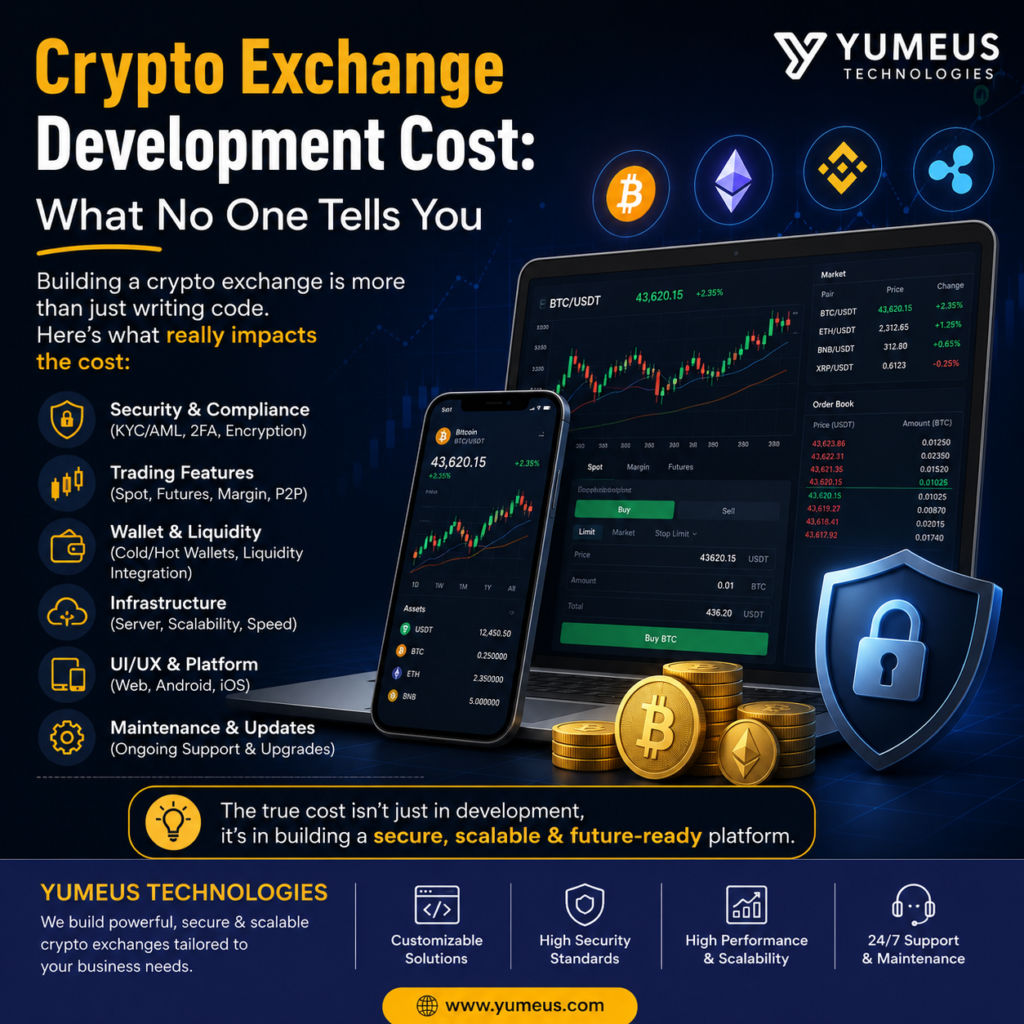

Introduction
Everyone wants a number. “How much does crypto exchange development cost?” is one of the most Googled questions in the blockchain space — and one of the most poorly answered.
Most articles throw out a range so wide it’s useless. “Between $10,000 and $500,000” tells you nothing. What actually drives that gap? What are you really paying for? And what costs quietly appear after launch that nobody warned you about?
This guide answers all of it — clearly, honestly, and without the filler.
What Is a Crypto Exchange — and Why Does Building One Cost What It Does?
A cryptocurrency exchange is a platform where users buy, sell, and trade digital assets — Bitcoin, Ethereum, altcoins, tokens, and increasingly, derivatives and NFTs.
Simple to describe. Complex to build.
Because what you’re actually engineering isn’t a website with a nice interface. It’s financial infrastructure that handles real money, real users, and real-time market data simultaneously — at scale — without going down. Ever.
That complexity is where the cost lives. A crypto exchange needs a high-speed order matching engine, multi-currency wallet architecture, KYC/AML compliance systems, DDoS-hardened security layers, a functional admin backend, and a mobile app that doesn’t crash when markets move fast. Each component takes a specialist to build. Each specialist has a day rate.
The crypto exchange development cost isn’t a single number because a crypto exchange isn’t a single thing. A basic white-label clone with a handful of trading pairs is a fundamentally different product from an institutional-grade platform handling millions in daily volume. Building the first takes weeks. Building the second takes over a year.
That’s the gap no headline figure ever explains — and it’s exactly what this guide breaks down, component by component.
What Is Crypto Exchange Development?
A cryptocurrency exchange is a platform that lets users buy, sell, and trade digital assets — Bitcoin, Ethereum, altcoins, tokens, and increasingly, derivatives and NFTs. Building one means engineering a system that handles real money, real users, and real-time market data simultaneously, at scale, without going down.
That’s not a website. It’s financial infrastructure.
Crypto exchange development covers everything from the trading engine and order-matching system to the user interface, wallet integration, KYC/AML compliance, admin panel, and security architecture. Some builders want a centralized exchange (CEX). Others want decentralized (DEX). Each path carries its own cost profile — and the development approach shapes your budget more than almost anything else.
Average Crypto Exchange Cost in 2026
Let’s start with honest numbers. Here’s where the crypto exchange cost in 2026 sits across build types:
| Build Type | Estimated Cost | Timeline |
| White-Label / Clone Solution | $10,000 – $40,000 | 4–8 weeks |
| Mid-Range Custom Build | $50,000 – $150,000 | 3–6 months |
| Enterprise-Grade Custom Exchange | $200,000 – $500,000+ | 6–18 months |
| DEX / DeFi Protocol | $80,000 – $300,000 | 4–12 months |
These aren’t arbitrary brackets. A white-label reuses existing architecture with cosmetic customization. A full custom build means your own trading engine, your own security framework — built from scratch by a team of blockchain engineers, backend developers, and security specialists.
Geography moves the needle significantly too. Development teams in North America or Western Europe charge $100–$250 per hour. Teams in India or Eastern Europe deliver comparable technical quality at $25–$80 per hour. On a 2,000-hour project, that’s a $150,000 difference on labor alone.
Cost to Develop a Cryptocurrency Exchange: Full Component Breakdown
The cost to develop a cryptocurrency exchange is the sum of its parts — and most budget conversations skip the parts that matter most. Here’s where the money actually goes:
- Trading Engine & Order Matching System — The core of your platform. Handles buy/sell matching in milliseconds. A poorly built engine kills user trust fast. Cost: $15,000–$60,000.
- Wallet Integration — Hot wallets for daily transactions, cold wallets for security. Multi-currency support multiplies complexity. Cost: $10,000–$30,000.
- User Interface & Experience — Trading dashboards, charts, order books, account management. Cost: $8,000–$25,000.
- KYC/AML Compliance Layer — Identity verification, document upload, sanctions screening. Not optional in any regulated market. Cost: $5,000–$20,000 plus ongoing API fees.
- Admin Dashboard — Fee management, user control, analytics. Often underbudgeted. Cost: $5,000–$15,000.
- Security Infrastructure — Two-factor authentication, DDoS protection, cold storage, penetration testing. Skimping here is how exchanges get hacked. Cost: $10,000–$40,000.
- Liquidity Integration — Connecting to external providers so your exchange has tradeable volume from day one. Cost: $5,000–$20,000 setup, plus ongoing fees.
A lean mid-market exchange with solid fundamentals lands between $60,000–$120,000. An enterprise platform with derivatives and margin trading pushes past $300,000.
Key Factors That Influence the Cost of Cryptocurrency Exchange Development
Two projects with identical feature lists can cost wildly different amounts. Here’s why:
Exchange type — A CEX has different architecture than a DEX. A P2P exchange differs from a derivatives platform. Each adds technical complexity and development hours.
Number of supported cryptocurrencies — Every blockchain integration takes engineering time. Supporting 10 coins costs far less than supporting 100.
Compliance requirements — Building for US or EU audiences means stricter regulatory layers. GDPR, FinCEN, and MiCA compliance aren’t free to implement and maintain.
Mobile app scope — Including a mobile app in your build affects the overall cryptocurrency exchange app development cost significantly. More on this in the next section.
Third-party integrations — Payment gateways, fiat on-ramps, charting libraries — each integration carries its own price tag and maintenance overhead.
Team structure — In-house team, outsourced development company, or freelancers each carry different cost and risk profiles. The cheapest option upfront is rarely the cheapest over 12 months.
Cryptocurrency Exchange App Development Cost: Mobile Is Not Optional
If you’re building a crypto trading platform in 2026 without a mobile app, you’re building for a shrinking audience. Over 60% of crypto trading now happens on mobile. The cryptocurrency exchange app development cost isn’t a luxury line item — it’s core infrastructure.
A standalone mobile app for an existing exchange typically costs:
- Cross-platform app (React Native/Flutter): $15,000–$35,000
- Native iOS + Android (separate builds): $30,000–$70,000
- Full-featured trading app with advanced charting: $50,000–$100,000+
The cross-platform route covers 90% of use cases for most first-time exchange operators. Native builds deliver better performance for high-frequency traders — but that’s a niche requirement most platforms don’t need at launch.
What drives crypto exchange app development cost upward: real-time price feeds, push notifications, biometric authentication, portfolio tracking, and in-app KYC flows. Strip these back for launch, then layer them in as revenue grows.
Hidden Costs No One Tells You About
This is the section most guides on cryptocurrency exchange app development costs skip entirely. The quoted build price is not your total investment. Not even close.
Server and hosting infrastructure — High-availability cloud infrastructure from day one costs $500–$5,000 per month, with spikes during market volatility.
Third-party API fees — KYC providers, market data feeds, payment processors, and liquidity APIs charge ongoing fees. A realistic estimate: $1,000–$8,000 per month.
Regulatory licensing — Operating legally in most jurisdictions requires a money services or crypto exchange license. Costs range from $5,000 in some regions to $100,000+ in others, plus ongoing legal compliance.
Security audits — Smart contract audits and penetration testing aren’t one-time events. Plan for quarterly reviews at $3,000–$15,000 each.
Maintenance and bug fixes — Industry standard is 15–20% of initial development cost per year. On a $100,000 build, that’s $15,000–$20,000 annually.
Marketing and liquidity — An exchange with no users is an expensive empty room. User acquisition, referral programs, and market-making to bootstrap trading volume all carry real costs.
The true first-year cost of operating a new exchange often runs 1.5x to 2x the initial development investment. Factor that in before you commit.
Cost Comparison: Custom Build vs. White-Label Solution
This single decision shapes your entire budget for crypto trading platform development:
| Factor | Custom Build | White-Label Solution |
| Initial Cost | $80,000–$500,000+ | $10,000–$40,000 |
| Timeline | 6–18 months | 4–8 weeks |
| Customization | Unlimited | Limited to template |
| IP Ownership | Full | Partial / licensed |
| Maintenance | Your responsibility | Often vendor-managed |
| Key Risk | Budget overruns, delays | Vendor lock-in |
White-label makes sense when you need to launch quickly, test the market, or have a tighter initial budget.
Custom development makes sense when you have a differentiated product vision, specific technical requirements, or an institutional audience that expects proprietary infrastructure.
The hybrid approach — starting white-label and rebuilding key components custom over time — is how many successful exchanges have scaled. You capture early market share without betting your entire capital on a ground-up build.
How to Optimize Your Crypto Exchange Development Cost
Getting to a lower number without cutting corners is entirely possible — if you’re strategic about where you save and where you don’t.
Launch with a tight MVP. Don’t build every feature before going live. Start with spot trading, core wallet support, and KYC compliance. Add derivatives and margin trading after your first user base validates the platform.
Use third-party APIs where they exist. Don’t build a charting library from scratch when TradingView integrates cleanly. Don’t build KYC in-house when established providers handle it more reliably. Spend engineering hours on your actual differentiators.
Fix scope before you sign anything. Scope creep is the single biggest cause of development cost overruns in crypto projects. Define your MVP feature list in writing, get it agreed before work starts, and establish a clear change management process for anything added later.
Negotiate maintenance terms upfront. Six to twelve months of post-launch support included in the original contract saves you significantly compared to renegotiating after bugs surface.
Why Choose Yumeus Technologies as Your Crypto Exchange Development Partner
Most crypto exchange projects don’t fail because of bad code. They fail because the wrong partner was chosen at the start — someone who quoted low, delivered late, and disappeared when post-launch questions arose.
Yumeus Technologies approaches the cost of developing a cryptocurrency exchange differently. The goal isn’t to sell you the most expensive build — it’s to deliver the right build for where your business actually is right now.
The cost case is concrete: Yumeus delivers enterprise-grade technical quality at mid-market pricing. For founders weighing $200,000 quotes from Western agencies against $12,000 quotes from unvetted freelancers, Yumeus sits in the credible middle — with the portfolio and team depth to prove it.
The timing case matters just as much. Crypto market cycles reward early movers. A partner that ships on schedule doesn’t just save money — it gives you positioning that late competitors can’t recover.
Every Yumeus exchange build includes a monetization-ready architecture from day one. Fee structures, referral systems, premium tiers, and liquidity provider integrations aren’t afterthoughts — they’re engineered in from the start.
And the scalability case is straightforward: the codebase you launch with should handle 10x user growth without a full rebuild. Yumeus designs for that trajectory, not just for launch day.
Ready to get a realistic estimate for your exchange? Talk to the Yumeus Technologies team — no pitch decks, just honest scoping.
conclusion
The cost of cryptocurrency exchange development in 2026 spans $10,000 to $500,000+ depending on build type, features, geography, and compliance requirements. Add ongoing infrastructure, licensing, security, and maintenance — and your real first-year investment runs 1.5x to 2x the initial quote.
That’s not a reason to avoid building. It’s a reason to plan honestly, scope your MVP tightly, and choose a partner who delivers what they promise.
The exchanges that win aren’t always the most technically complex ones. They’re the ones that launched at the right time, with solid fundamentals, built by a team that actually showed up.
Frequently Asked Questions
What is the average crypto exchange development cost in 2026? Most mid-range custom exchanges land between $50,000 and $150,000. White-label solutions start from $10,000, while enterprise-grade platforms can exceed $500,000. Your number depends on exchange type, feature set, compliance requirements, and whether you include a mobile app.
What’s included in the cryptocurrency exchange app development cost? Mobile app development covers UI/UX design, real-time trading functionality, wallet integration, biometric authentication, push notifications, and KYC flows. Cross-platform builds run $15,000–$35,000; native iOS and Android separate builds cost $30,000–$70,000+.
Are there ongoing costs after launch? Yes — and they’re significant. Server hosting, API subscriptions, security audits, maintenance, and licensing fees collectively run $3,000–$15,000 per month or more. Plan for first-year ongoing costs to equal 50–100% of your initial development investment.
Is a white-label exchange worth it over a custom build? For fast market entry and lean budgets, white-label wins. For differentiated product vision and long-term IP ownership, custom wins. Many successful exchanges start white-label, validate with real users, then rebuild key components custom as revenue grows.
How do I reduce development cost without compromising security? Launch a tight MVP, use established third-party APIs instead of building everything in-house, and choose an experienced development team with a verifiable blockchain portfolio. Never cut on trading engine reliability, wallet security, or KYC compliance — those savings become liabilities fast.