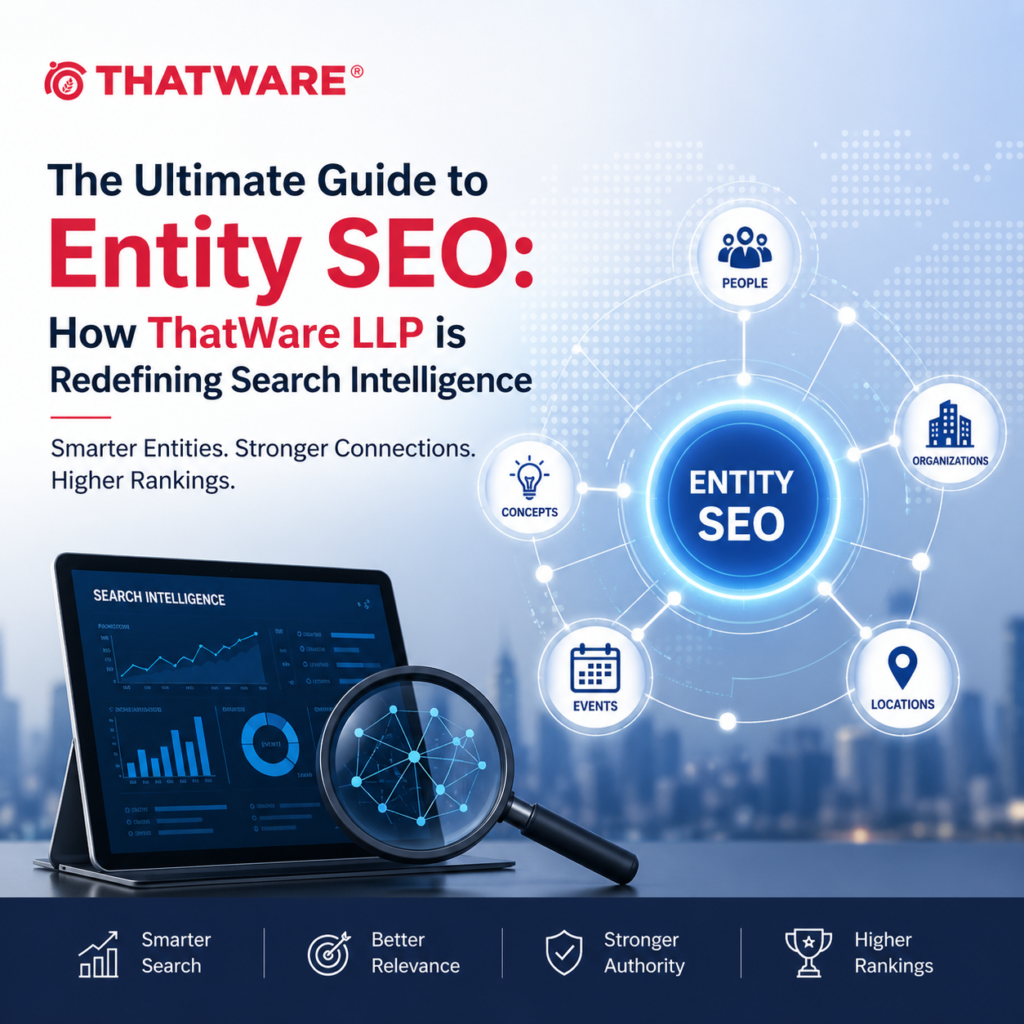

In the earlier days of digital marketing, the formula for success was relatively simple: find a high-volume keyword, sprinkle it throughout your content, and wait for the search engine to reward your efforts. However, as search engines have evolved into sophisticated answer engines, the “strings to things” revolution has taken center stage. Today, search is no longer about matching characters; it is about understanding the world.
At ThatWare LLP, we have pioneered the shift toward semantic clarity. We believe that for a brand to truly dominate the modern SERP, it must move beyond traditional keyword tactics and embrace a holistic, entity-driven approach. This guide explores how entity SEO, structured data, and knowledge graph optimization work together to build a search-recognized brand.
1. Understanding Entity-Based Search Optimization
An entity is a clearly defined, uniquely identifiable thing or concept—be it a person, a place, a product, or even an abstract idea. Unlike keywords, which are just text, entities carry independent meaning and context.
Entity-based search optimization is the process of teaching search engines exactly what your brand represents and how it relates to other established concepts in its industry. When you optimize for entities, you are essentially providing Google with a blueprint of your business’s identity. This reduces ambiguity—helping Google distinguish between “Apple” the fruit and “Apple” the technology giant—and ensures your content is surfaced for the most relevant user intents.
2. The Power of Brand Knowledge Graph Optimization
Google’s Knowledge Graph is a massive database of billions of entities and the relationships between them. For a business, being recognized as a distinct entity within this graph is the “holy grail” of SEO.
Through brand knowledge graph optimization, ThatWare LLP helps businesses establish a “Source of Truth.” This involves:
-
Consistency Across Platforms: Ensuring your name, address, and brand story are identical across social profiles, local listings, and your website.
-
Authoritative Citations: Securing mentions from trusted databases like Wikipedia or industry-specific repositories.
-
Relationship Mapping: Explicitly linking your brand to the core topics you want to own.
When Google recognizes your brand as an authoritative entity, you gain access to premium SERP real estate, including Knowledge Panels and rich snippets, which significantly boost trust and click-through rates.
3. Strengthening Entity SEO with Structured Data
If the Knowledge Graph is the library, then schema markup is the indexing system. You cannot expect search engines to guess the relationships within your content; you must declare them.
Implementing entity SEO with structured data allows you to “label” the people, services, and products on your site in a machine-readable format (JSON-LD). At ThatWare LLP, we utilize advanced schema types such as:
-
Organization Schema: To define the brand entity.
-
MainEntityOfPage: To signal the primary topic of a specific URL.
-
SameAs: To link your website to other authoritative profiles like LinkedIn or Crunchbase.
This technical layer acts as a bridge, translating your human-written content into a format that AI-driven search bots can digest with 100% certainty.
4. The Rise of Entity-Driven SEO Intelligence
The digital landscape is shifting toward entity-driven SEO intelligence. Search engines like Google and Bing now use Natural Language Processing (NLP) to extract entities from unstructured text. This means your content strategy must focus on “topical clusters” rather than isolated keywords.
By covering a topic comprehensively—addressing subtopics, related questions, and expert insights—you build topical authority. This intelligence-led approach ensures that your brand isn’t just ranking for a single term but is viewed as the definitive resource for an entire subject area. ThatWare LLP leverages AI to identify these semantic gaps, ensuring our clients’ content is always one step ahead of the algorithm.
5. Future-Proofing: Entity Optimization for LLMs
With the rise of ChatGPT, Google Gemini, and Search Generative Experiences (SGE), the way users consume information has changed. These models don’t just provide links; they provide answers.
Entity optimization for LLMs is about ensuring your brand is cited as a primary source by these Large Language Models. LLMs rely on clear entity associations to generate accurate summaries. If your brand is well-defined as an entity with high trust signals, AI systems are far more likely to recommend your services in their generated responses. At ThatWare LLP, we fine-tune your digital footprint to ensure your brand remains visible in the age of conversational AI.
Conclusion: Lead the Search Revolution with ThatWare LLP
The transition from keywords to entities is the most significant shift in search history. It requires a blend of technical precision, semantic expertise, and strategic content creation. By focusing on how your brand connects to the broader web of knowledge, you create a digital presence that is resilient to algorithm updates and optimized for the future of AI.
Are you ready to transform your brand into a search-recognized authority? Explore our advanced SEO solutions and let ThatWare LLP help you navigate the complexities of the semantic web.