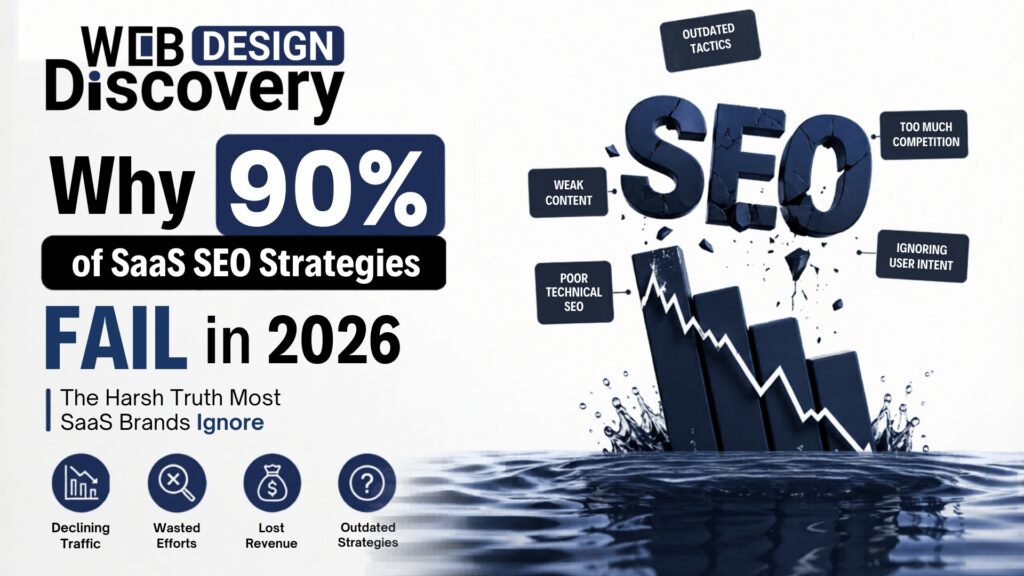

Most SaaS companies don’t fail at SEO because they lack effort — they fail because they follow outdated playbooks in a completely new search landscape.
In 2026, search is no longer just about rankings. It’s about experience, intent, and real usefulness. If your SaaS SEO strategy still revolves around keywords and blog volume, you’re already behind.
Let’s break down why most SaaS SEO efforts fail today — and what actually works now.
The Real Problem: SaaS SEO Has Changed Faster Than Most Teams
Search engines have evolved. AI-driven results, zero-click searches, and intent-based ranking systems mean:
- Users get answers without clicking
- Google prioritizes real experience over generic content
- Content quality matters more than quantity
But many businesses still treat SEO for SaaS like it’s 2018.
That mismatch is the reason most strategies collapse.
1. They Focus on Traffic Instead of Revenue
A major mistake in SaaS SEO is chasing traffic numbers.
More blog posts. More keywords. More impressions.
But here’s the truth:
👉 Traffic without intent doesn’t convert.
Many SaaS brands rank for:
- Informational keywords
- Low-buying intent searches
- Irrelevant global audiences
What works in 2026:
- Focus on high-intent keywords
- Align content with product use cases
- Build pages that answer “should I buy this?” not just “what is this?”
2. Weak Product–Content Alignment
One of the biggest gaps in a failing saas seo strategy is disconnect.
Blogs talk about general topics, while the product solves specific problems.
Example:
- Blog: “What is project management?”
- Product: Advanced SaaS workflow tool
There’s no bridge.
Modern SaaS SEO fixes this by:
- Creating feature-led content
- Using real product workflows in content
- Showing how the tool solves actual problems
This is where a strong saas seo consultant or team brings real value — connecting SEO with product reality.
3. Ignoring SaaS Technical SEO
Many SaaS websites are technically complex:
- JavaScript-heavy frameworks
- Poor crawlability
- Duplicate dynamic pages
- Slow loading dashboards
Ignoring saas technical seo kills rankings silently.
Common technical issues:
- Pages not indexed properly
- Broken internal linking
- Poor Core Web Vitals
- Weak site structure
What works now:
- Clean URL structures
- Strong internal linking (feature → blog → use case)
- Fast-loading pages
- Proper indexing control
Without this, even great content won’t rank.
4. Over-Reliance on AI Content (Without Human Experience)
AI content is everywhere — but most of it sounds the same.
Google’s 2026 updates strongly reward:
- First-hand experience
- Real insights
- Practical examples
Generic AI blogs fail because they:
- Repeat surface-level information
- Lack depth
- Don’t solve real problems
Winning SaaS SEO content includes:
- Case studies
- Real workflows
- Founder or team insights
- Actual user scenarios
This is the “Experience” in E-E-A-T — and it’s non-negotiable now.
5. No Clear Funnel Strategy
Most SaaS SEO strategies treat all content equally.
But users are at different stages:
- Awareness → learning
- Consideration → comparing
- Decision → choosing tools
If your content doesn’t guide users through this journey, you lose them.
Effective SaaS SEO structure:
- TOFU: Educational blogs
- MOFU: Comparison + solution content
- BOFU: Landing pages + product-focused content
This structured saas seo agency approach is what separates growth-focused brands from content-heavy ones.
6. Poor Internal Linking and Content Structure
Even good content fails when it’s disconnected.
Many SaaS websites:
- Publish blogs but don’t link them properly
- Don’t connect content to product pages
- Miss topic clustering
In 2026, SEO works like a system, not isolated pages.
What works:
- Topic clusters around core features
- Strategic internal linking
- Clear content hierarchy
This helps both users and search engines understand your authority.
7. Choosing the Wrong Keywords
A lot of SaaS brands target:
- High-volume keywords
- Competitive generic terms
But ignore:
- Long-tail keywords
- Problem-based searches
- Buyer-intent queries
Example:
- Weak: “CRM software”
- Strong: “CRM for small sales teams with automation”
Modern saas seo services focus on:
- Intent > volume
- Relevance > competition
- Conversion > clicks
8. No Measurement Beyond Rankings
Ranking #1 doesn’t guarantee success anymore.
If your SEO reporting only tracks:
- Keyword positions
- Traffic
You’re missing the real picture.
What actually matters:
- Signups from organic traffic
- Product page engagement
- Conversion rates
- Assisted conversions
Top-performing SaaS teams treat SEO like a growth channel, not just visibility.
What Actually Works in SaaS SEO in 2026
After analyzing successful SaaS brands, the pattern is clear:
They focus on:
- Real user intent
- Product-led content
- Strong technical foundation
- Content depth, not volume
- Conversion-focused pages
They avoid:
- Generic AI content
- Traffic-only strategies
- Disconnected blog writing
- Ignoring technical SEO
Final Thought
The difference isn’t tools, budgets, or even content volume.
It’s clarity.
Top SaaS brands:
- Understand their users deeply
- Build SEO around real problems
- Connect content directly to product value
After going through multiple strategies, experiments, and industry case studies, one thing becomes clear — the teams that win are those who treat SEO as a growth system, not just a marketing task.
And while exploring different approaches and frameworks, I came across insights and structured execution methods shared on Webdesign Discovery. What stood out wasn’t promotion, but a practical understanding of how modern SaaS SEO actually works — especially when it comes to aligning content, technical SEO, and conversion.
That kind of clarity is rare — and in 2026, it’s exactly what makes the difference.
FAQs
1. What is a SaaS SEO strategy?
A SaaS SEO strategy focuses on attracting, educating, and converting users through content that aligns with the product and solves real user problems.
2. Why is SEO for SaaS different from regular SEO?
SaaS SEO involves longer sales cycles, product education, and multiple decision stages, making content strategy more complex and conversion-focused.
3. How important is technical SEO for SaaS websites?
Very important. Without proper saas technical seo, even high-quality content may not rank or get indexed properly.
4. Do SaaS companies still need blogs in 2026?
Yes, but not generic blogs. Content must be useful, experience-based, and connected to product solutions.
5. Should SaaS companies hire an SEO agency or consultant?
It depends on internal expertise. A skilled b2b saas seo agency or experienced consultant can help align SEO with real business goals.