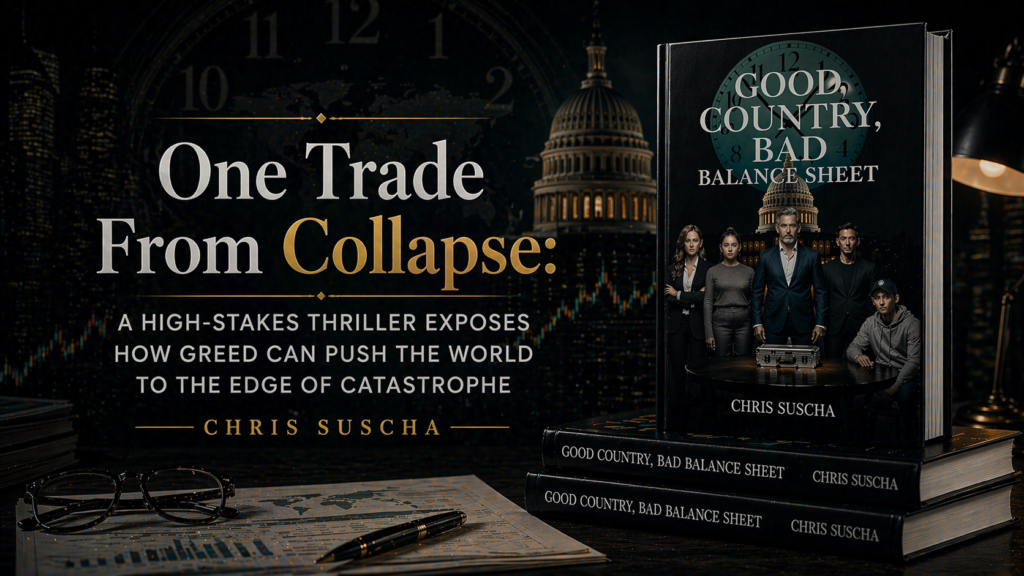

What happens when the pursuit of profit collides with the survival of an entire system? What if one individual, driven by ambition and opportunity, could bring the global economy to the brink—not by accident, but by design?
In Good Country, Bad Balance Sheet, author Chris Suscha delivers a gripping financial thriller that explores one of the most volatile forces in modern markets: greed. Set against the backdrop of an impending national default, the story reveals how the drive for outsized gain can escalate into a threat so large it endangers the system itself.
Blending technical realism with cinematic intensity, the novella examines the razor-thin line between strategic brilliance and catastrophic risk-taking—where the difference between success and disaster is measured in timing, scale, and consequence.
At its core, the book presents a stark reality: in a system built on incentives, greed is not an anomaly—it is a feature. And when left unchecked, it can become existential.
WHEN PROFIT BECOMES THE PRIORITY
Modern financial systems are driven by incentives. Markets reward performance, innovation, and risk-taking. The pursuit of profit fuels growth, drives efficiency, and encourages competition.
But Good Country, Bad Balance Sheet challenges the assumption that these incentives always lead to positive outcomes. Under certain conditions, the same forces that drive success can also drive instability.
In the narrative, a single actor identifies an opportunity not just to profit from market conditions, but to exploit the very structure of the system. The goal is not incremental gain—it is unprecedented return, achieved by positioning against the stability of the system itself.
This shift transforms profit-seeking into something far more dangerous.
THE SCALE OF MODERN RISK
One of the most compelling aspects of the book is its portrayal of scale. In today’s financial environment, positions are no longer measured in millions—they are measured in billions, and sometimes hundreds of billions.
This scale amplifies both opportunity and risk. A well-timed strategy can generate extraordinary returns. A miscalculation can trigger cascading failures.
Good Country, Bad Balance Sheet captures this dynamic with precision, illustrating how a single trade, executed at sufficient scale, can influence markets, distort pricing, and destabilize entire systems.
At this level, individual decisions have global consequences.
WHEN STRATEGY TURNS INTO THREAT
The narrative explores how a strategy designed for profit can evolve into a systemic threat. As positions grow and dependencies increase, the success of the trade becomes tied to the failure of the system.
This creates a dangerous feedback loop. The more the strategy depends on disruption, the greater the incentive to accelerate that disruption.
Good Country, Bad Balance Sheet brings this tension to life, showing how the line between calculated risk and deliberate destabilization can blur under pressure.
In this environment, the question is no longer how to win—but what must break in order to do so.
THE HUMAN PSYCHOLOGY OF GREED
At the heart of the story is not just a financial dynamic, but a psychological one. Greed is not portrayed as a simple desire for wealth, but as a complex interplay of ambition, confidence, and justification.
The character driving the central threat believes in the logic of the trade. The numbers make sense. The opportunity is real. And the potential reward is unlike anything that has come before.
Good Country, Bad Balance Sheet explores this mindset with nuance, showing how rational decision-making can coexist with increasingly extreme outcomes.
It is not recklessness—it is conviction taken to its limit.
THE SYSTEM’S VULNERABILITY TO EXPLOITATION
The book also highlights how complex systems can be vulnerable to exploitation. Financial structures, designed for efficiency and scale, can contain hidden weaknesses that are difficult to detect until they are tested.
In the narrative, these weaknesses are identified and leveraged with precision. The system is not attacked directly—it is allowed to collapse under its own internal pressures.
This approach underscores a critical insight: the greatest threats to a system often come from within, not from outside.
A TIMELY EXAMINATION OF MODERN MARKETS
In an era characterized by high leverage, complex instruments, and interconnected systems, the tension between profit and stability feels increasingly relevant.
Good Country, Bad Balance Sheet captures this reality, offering a narrative that reflects the challenges and risks inherent in modern finance. It raises important questions about how incentives are structured, how risk is managed, and how far individuals are willing to go in pursuit of success.
By doing so, it provides a lens through which to better understand the forces shaping today’s markets.
ABOUT THE BOOK
Good Country, Bad Balance Sheet is a high-intensity financial thriller that explores the intersection of ambition, systemic risk, and market dynamics. Combining technical authenticity with cinematic storytelling, it offers a compelling perspective on how individual actions can shape—and threaten—the stability of global systems.
AVAILABILITY
Good Country, Bad Balance Sheet is available now.
Contact
Author: Chris Suscha
Email: csuscha@gmail.com
Website: https://chrissuscha.com/