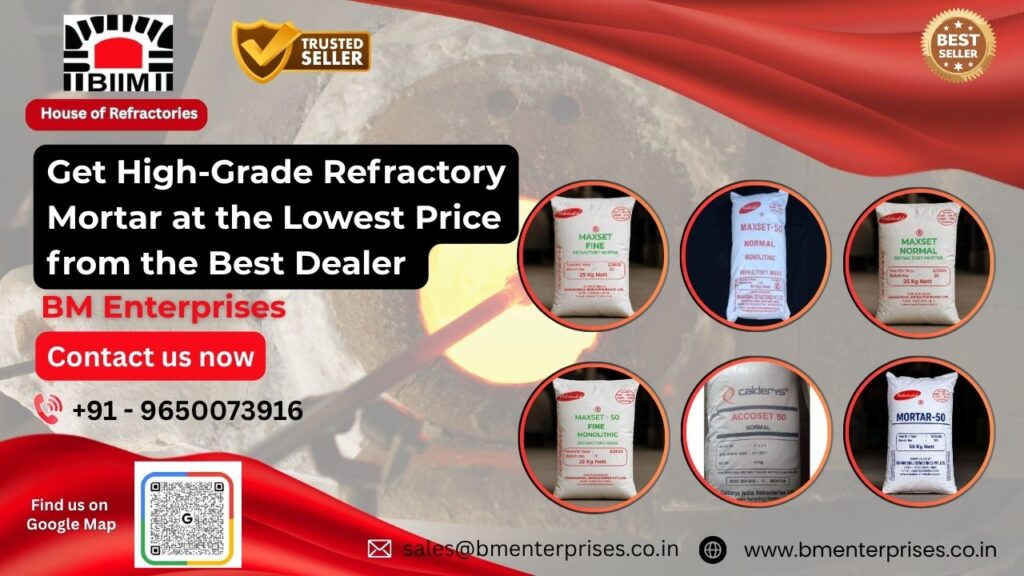
Are you wondering what kind of substance binds together high-temperature bricks inside the furnace, kiln, or boiler? If so, the answer is refractory mortar. Refractory mortars are designed to resist high temperatures without experiencing any shrinkage, cracking, or weakening of the structure. Refractory mortar is different from standard cement since it is designed to contain heat-resistant ingredients to prevent damage caused by heat.
In other words, refractory mortar can be described as a kind of “glue” that holds fireproof bricks together in conditions of extreme heat and pressure. Without this glue, the whole structure consisting of the refractory brick will inevitably degrade over time. Whether your goal is to maintain a furnace inside a steel production plant or a ceramic kiln, you need to focus on finding a good mortar supplier.
Why High-Quality Mortar Matters in Industrial Applications
The use of poor-quality refractory mortar in hot zones is like constructing a home from sand; you may be able to stay put for a while, but sooner or later, it will collapse. The use of high-grade refractory mortar guarantees longevity, saves on maintenance costs, and increases efficiency.
The use of high-grade refractory mortar also promotes efficient sealing of bricks together to minimise heat loss in the process. Such aspects go a long way to influencing productivity in plants. Therefore, by choosing a reputable refractory mortar provider, one can rest assured of quality service and performance.
Why Choose BM Enterprises as Your Refractory Mortar Supplier
Trusted Refractory Mortar Dealer in India
In terms of acquiring high-grade refractories, BM Enterprises has made itself known as a reliable organisation. The company’s long-standing experience in the industry and its reputation have positioned it as a leading refractory mortar supplier in India. BM Enterprises takes pride in meeting the unique demands of each industry with its tailor-made products.
BM Enterprises is aware of the technical specifications required by each sector. Therefore, it offers customised mortar for all kinds of industries, such as those used in high-temperature furnaces.
Competitive Pricing Without Compromising Quality
Be real: Price is important. But wouldn’t you love to enjoy high-quality products at rock-bottom prices? This is what BM Enterprises provides. Using efficient supply chain strategies and direct source procurement, they make sure that their prices remain low without sacrificing product quality.
Such a combination of efficiency and high quality makes BM Enterprises a reliable choice for refractory mortar suppliers.
Types of Refractory Mortar Offered by BM Enterprises
Maxset 50 Normal (Accoset 50 Normal)
The Accoset 50 Normal or Maxset 50 Normal product can be used in moderate to high-temperature situations where toughness and strong bonding are vital. With good adhesive and heat-resistant properties, it can be applied in furnaces and kilns. The balanced nature of the product guarantees an easy application process that ensures its longevity.
Specifications
Maximum Temperature of Service: 1500°C
Content of Alumina: ~50%
Product State: Powder form
Granule Size: Moderate
Density of Set Product: 1.8 – 2.0 g/cm³
Bonds: Hydraulic/Air-setting
Method of Application: Hand or trowel application
Setting Process: Moderate
Package Weight: 25 kg / 50 kg per bag
Features
Heat-resistant for moderate to high-temperature regions
Superb bonding ability with fire bricks
Little shrinkage even after repeated heating sessions
Very tough to withstand the shocks of rapid cooling and heating
Easy application and mixing due to good workability
Inexpensive alternative to other industrial furnace lining products
Accoset Normal (Maxset Normal)
Accoset Normal mortar is a multipurpose refractory mortar that can be used for different industrial requirements. This material offers adequate bonding strength and heat resistance at affordable prices. It is highly convenient to apply and is widely used by engineers.
Specifications
Maximum Service Temperature: Up to 1350°C
Alumina Content: 35% – 40%
Physical Form: Powder
Grain Texture: Standard
Bulk Density: 1.7 – 1.9 g/cm³
Bonding Type: Air-setting
Application Thickness: 2–5 mm joints recommended
Packaging: 25 kg bags
Features
Perfect for general-purpose refractory work
Offers excellent bonding with standard refractory brick materials
Easy to handle and apply
Affordable price
High adhesive and cohesive qualities
Useful for repairs and maintenance tasks
Accoset Fine (Maxset Fine)
Accoset Fine comes through when accuracy is key. The fine particle size helps create accurate joints, thereby reducing heat loss. Accoset Fine is ideal for precise brickwork and bonding.
Specifications
Highest Service Temperature: 1400°C
Alumina Content: About 40%
Form: Fine powder
Particle Size: Fine (applications with a smooth surface finish)
Density: 1.75 – 1.95 g/cm³
Type of Bond: Air setting or chemical bond
Joint Thickness: 1–3 mm (fine joints)
Packing: 25 kg bags
Features
Fine particle size for accurate bonding and joints
Minimises heat loss through effective sealing
Suitable for fine joints in brickwork and lining
Air gaps are minimised, making the insulation process more efficient
Easy to use for intricate purposes
Ideal for kilns and furnace construction
Accoset 50 Fine (Maxset 50 Fine)
The formulation of this accoset 50 fine mortar material has combined strength and fine application properties. This makes it best suited for high-value applications where strength and precise applications are required. Its excellent formulation makes it perfect for its intended use.
Specifications
Max Working Temperature: 1550°C
Alumina Content: Approx. 50%
Physical Properties: Fine powder
Particle Size: Ultra-fine
Density: 1.9 – 2.1 g/cm³
Binder Type: High Strength Chemical Bond
Applications: Precision Bonding in thin layers
Package Weight: 25kg/50kg Bags
Features
A combination of high alumina strength and fine application precision
Excellent binding at critical high-temperature regions
Excellent heat shock resistance and chemical resistance
Dense and even joint formation
Perfect for high-performance furnaces used in industries
Long lifespan with low maintenance requirements
Refractory Mortar 50
Refractory Mortar 50 proves to be a highly versatile material used for an array of industrial applications. It is characterized by good heat resistance and excellent bonding capacity, and it can therefore be successfully applied to furnaces, boilers, and kilns.
Specifications
Maximum Service Temperature: Up to 1500°C
Alumina Concentration: ~50%
Physical State: Powder
Grain Size: Medium to fine
Density: 1.8 – 2.0 g/cm³
Binding System: Air-setting/Heat-setting
Purpose: General-purpose refractory mortar
Packing: 25 kg/50 kg bags
Features
Excellent bonding capacity
High temperature resistance
Applicable for furnaces, boilers, and kilns
Durable under thermal loads
Resistant to wear and tear
Wide applicability in various industries
Quick Comparison Table
Product Name
Temp. Resistance
Alumina %
Texture
Best Use
Maxset 50 Normal
Up to 1500°C
~50%
Medium
Furnaces, kilns
Accoset Normal
Up to 1350°C
35–40%
Standard
General applications
Accoset Fine
Up to 1400°C
~40%
Fine
Thin joints, precision work
Accoset 50 Fine
Up to 1550°C
~50%
Ultra-fine
High-performance furnaces
Refractory Mortar 50
Up to 1500°C
~50%
Medium/Fine
Industrial lining
Applications of Refractory Mortar in Industries
Steel, Cement, and Power Plants
In industries involving heavy production such as steel and cement, refractory mortar is vital for ensuring efficiency in operations. It guarantees that furnaces and kilns continue operating optimally despite prolonged exposure to extreme temperatures.
Furnaces, Kilns, and Boilers
In all types of furnaces, kilns, and boilers, the use of refractory mortar is essential. Not only does it help hold the construction together, but it also improves insulation, lowering energy requirements.
Why BM Enterprises Stands Out as a Refractory Mortar Distributor in India
BM Enterprises does not merely supply products but offers solutions. The wide variety of their products, technical knowledge, and customer-focused philosophy make BM Enterprises the foremost refractory mortar distributor in India.
Pricing Advantage – Get the Lowest Price Guaranteed
In today’s highly competitive world, cost savings are very important. BM Enterprises ensures you receive the lowest price while maintaining the same high quality, making them the most popular refractory mortar supplier in India.
Quality Standards and Assurance
It should be noted that when it comes to refractory materials, quality simply cannot be compromised. Our company is known for maintaining a high level of quality control in manufacturing processes, which ensures that our products meet the highest industry standards.
Conclusion
Your choice of refractory mortar may become critical for your industrial activities, and there is no need to look further than BM Enterprises. We offer you high-quality products, reasonable prices, and professional support. From Maxset 50 Normal to Refractory Mortar 50, choose the best.
FAQs
1. What are the differences between regular and fine refractory mortars?
Fine mortar is more refined and provides better accuracy, whereas regular mortar serves as a binding agent.
2. Why do furnaces require refractory mortar?
Refractory mortar creates an excellent bond and insulates the structure, ensuring that no heat escapes.
3. Who supplies the best refractory mortars in India?
BM Enterprises offers excellent services in terms of quality and prices.
4. Can refractory mortar resist extreme temperatures?
Certainly, good refractory mortar can resist temperatures above 1000°C.
5. What are the factors to consider when choosing refractory mortar?
The application purpose and temperature must be taken into consideration.