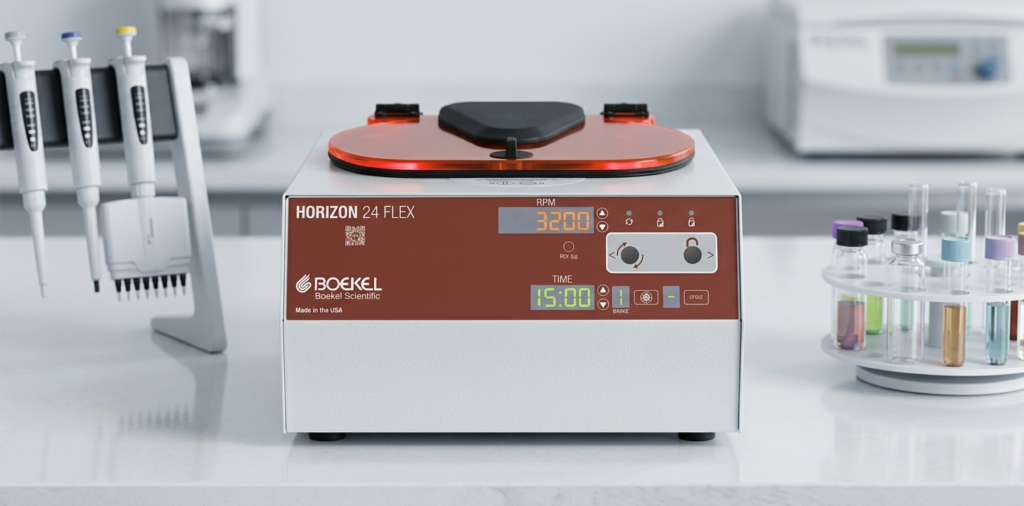

Centrifuges are used in many laboratories for separating particles from liquids based on their density. They spin samples very fast, which pushes the heavier particles to the outside while the lighter ones stay closer to the center. In research and clinical settings, these are essential for processes like separating blood components, isolating cells, and purifying proteins.
To know more about laboratory centrifuges, their working, types, components, and key features, keep reading.
An Overview of Centrifuges
A centrifuge is a machine that laboratories use to separate liquids, gases and solids. The machine applies centrifugal force to spin samples at high speed, pushing heavier particles toward the container’s outside and lighter ones toward the center. Using this process, laboratories separate liquids from solids, for example, separating blood cells (red blood cells, white blood cells, or platelets) from plasma or proteins from a solution. In addition, centrifuges are used to purify cells and viruses in molecular biology and clinical diagnostics.
How do Centrifuges Work?
A centrifuge comes equipped with a motor that powers the machine to spin liquid samples at high speed (typically measured in revolutions per minute) and generates a powerful centrifugal force. This force then pushes heavier particles outward, letting the substances separate quickly. The main component of the machine is the rotor, which is connected to the motor and holds the sample tubes during the spinning process. There are different types of rotors, and the best type for you depends on your specific application needs.
Different Types of Centrifuges
Lab applications differ, so the type of centrifuge you need also depends on the task. Different centrifuges are designed for different purposes, sample sizes, and speed requirements. Choosing the right type is essential to ensure you get accurate experimentation results every time. So, let’s go through some of the common types of lab centrifuges for sale.
Benchtop Systems
These are also called benchtop centrifuges and are used in general-purpose labs. Their speed can range from 3000 to 7000 g, making them ideal for separating small samples like red blood cells and yeast cells. Because they are compact, they are perfect for labs where researchers need to perform basic separations.
Ultracentrifuges
Ultracentrifuges work at a very high-speed up to 1,000,000g, much faster than standard centrifuges. They are designed to separate small particles such as proteins, viruses, and DNA. Their high speed creates a very strong force that separates even the tiniest particles quickly and accurately, ensuring precise results in advanced research laboratories.
Refrigerated Centrifuges
Refrigerated centrifuges are used in laboratories where samples need to be preserved at a consistent temperature. They have a built-in cooling system that stops heat buildup when the machine is running. This creates an environment that maintains stable temperatures for temperature-sensitive samples such as blood, proteins, and enzymes.
What are the Components of a Lab Centrifuge?
Centrifuge looks like a single machine, but it actually consists of several key components that play a huge role in its functionality. Let’s take a look at them below:
Rotor
As we learned above, the rotor is connected to the centrifuge motor and holds sample tubes. When the machine runs, it generates a centrifugal force that allows for the sample separation.
Motor
The motor is the heart of the centrifuge, which is responsible for powering the rotor to work at the required centrifugation speed. The motor speed is usually measured in revolutions per minute and can range from a few thousand to over 100,000 RPM, depending on which model you’re choosing.
Tubes
Tubes are containers that hold samples during the spinning process. These tubes are made of either glass or plastic. If I talk about glass tubes, they’re resistant to chemicals and offer great durability for processes. On the other side, plastic tubes are also safer, durable, and shatter-resistant. Plus, they are cost-effective.
Panel
Centrifuges also have control panels, which users can use to set and monitor the speed, time, and temperature (in refrigerated models). You’ll also find features such as digital displays, alarm systems, and preset programs in some advanced models.
Key Factors to Consider When Choosing a Lab Centrifuge
Accurate results can only be achieved if the selected lab centrifuge is suitable for the application, properly maintained, and operated under the correct conditions. Below, I have outlined the key consideration factors that would help you make the right decision and pick the appropriate centrifuge for your needs.
Sample Type
Different samples like blood, urine, or chemical solutions require varying spinning speeds, rotor setups, and temperature controls. First, identify your sample types so you can choose the model that’s compatible with maximum separation quality.
Speed
Speed also varies in different centrifuges. For separate smaller or complex particles, you need a centrifuge with high speed for accurate results. On the other hand, basic applications require centrifuges with a lower speed range.
Rotor
Different types of rotors include fixed-angle, swing-out, and specialized rotors. Fixed-angle rotors enable quick and high-speed sample separation. Swing-out rotors are ideal for applications where samples need to be separated in a uniform way. Specialized rotors work well for tasks like working with microtubes or large-volume samples.
Temperature Control
If you work often with temperature-sensitive samples, choose a refrigerated centrifuge that maintains a stable temperature. But make sure to pick one with rapid cooling capacity and a pre-cooling function.
Safety Features
Safety is paramount when working with sample separation. So look for models that have built-in safety features like lid locks, imbalance detection systems, speed and temperature monitoring, and automatic shut-off. With these features, you can work safely and ensure reliable operation every time.
Final Thoughts
Sample separation is a key task in research and clinical settings, and a lab centrifuge ensures this process is done quickly and accurately. Whether it’s a small, complex particle or larger components, there are different types of centrifuges designed for different application needs. But choosing the right one is essential to ensure accuracy. By understanding the key factors, you can find it easy to buy a centrifuge that meets your needs and provides consistent results every time you run your processes.