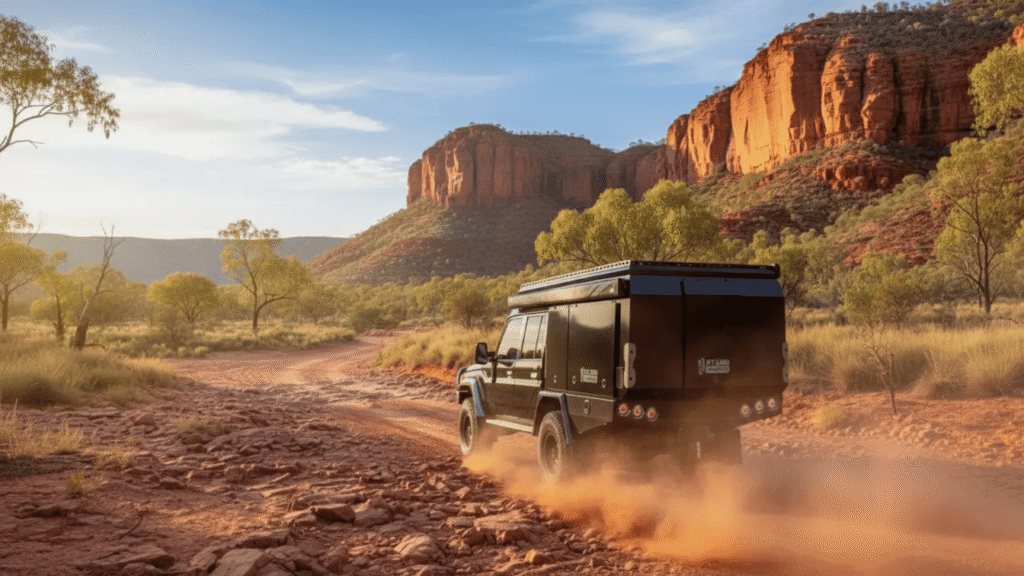

Most people spend weeks comparing caravans and motorhomes then completely overlook the one option built for how Australians actually travel. Slide on campers Australia explorers are choosing today are purpose-built for remote terrain, long distances, and true off-grid living. If you own a ute or truck and want real freedom on the road, this guide will help you make a smart, informed decision before you spend a single dollar.
What Exactly Is a Slide On Camper?
A slide-on camper is a self-contained living unit that mounts directly onto the tray of a ute or truck. It uses your vehicle as its foundation. There is no towing involved, no trailer registration, and no extra set of wheels to maintain on a corrugated outback track.
Once at your campsite, the camper lifts off your tray on four motorised legs. You drive your ute out from underneath, set it free, and use your vehicle independently while camp stays set up. That is something no caravan in the world can offer you.
Why Australia Demands a Different Kind of Camper
Australia is unlike anywhere else on the planet. More than 70% of the country is remote or semi-arid. When you are travelling 1,000 km between towns, equipment failure is not an inconvenience — it is a serious problem.
Towing a trailer through that adds axles, tyres, brakes, and suspension — all extra points of failure. A slide-on removes that risk entirely. It sits on your existing vehicle. One set of wheels. One drivetrain. Far fewer things to go wrong.
Tracks across the outback are also increasingly closing access to trailers. Environmental damage and safety concerns are pushing land managers to restrict towed vehicles. A slide-on camper keeps you legal and moving when a trailer would turn you around at the gate.
What’s Inside a Modern Slide On Camper?
This is where things have changed dramatically over the last few years. Today’s ute campers are not stripped-back shelters. They are fully equipped, off-grid capable homes on a tray.
A well-built slide-on will include a king or queen bed, internal lounge and dining space, a private ensuite with a slide-out toilet, hot water, a full kitchen setup, and serious electrical systems. Some models carry 900Ah to 1200Ah of battery storage paired with 640W to over 1000W of rooftop solar.
All-electric systems have replaced gas in the better-built models. That means no gas bottles to manage, no rear venting that pulls in road dust, and no naked flame inside your camper on a hot Australian summer night. Everything runs on solar and battery — quietly and cleanly.
Slide On Campers for Sale: What to Check Before You Buy
Browsing slide on campers for sale is exciting. But excitement can cost you money if you skip the basics. Here is what actually matters.
Know your payload before anything else. Payload is the gap between your vehicle’s gross vehicle mass and its tare weight. Sounds simple. It is not. Bull bars, winches, dual batteries, a full fuel tank, water, and passengers all eat into that number fast. Before you fall in love with a camper, get your actual available payload confirmed in writing.
Weight distribution is just as important as total weight. A camper loaded behind your rear axle will affect your steering, braking, and tyre wear. The best designs position heavy items — batteries, water tanks, fridge — as close to the centre of the wheelbase as possible.
Check the build material. Fibreglass looks clean but it cracks and is difficult to repair in the field. Lightweight aluminium alloy handles vibration, heat, and rough corrugations far better. It is also easier to fix if something goes wrong 500 km from the nearest town.
Understand the warranty. A five to ten year structural warranty is the standard to expect from a quality manufacturer. More importantly, check whether the warranty covers off-road use and whether the company will post parts directly to you while you are touring.
When comparing slide on campers for sale, do not just look at the sticker price. Look at total cost — insurance, compliance, compatibility, and long-term support.
Is a Slide On Right for Your Ute?
Most modern dual-cab utes are compatible with slide-on campers. Models like the Toyota HiLux, Ford Ranger, Isuzu D-MAX, Mitsubishi Triton, and Nissan Navara are all widely supported. The key is confirming the tray dimensions match and that your payload allows for the camper weight plus your gear, water, and food for an extended trip.
Single-cab and extra-cab configurations work well too — sometimes better, since they often carry higher payload ratings than dual-cabs.
The Real Cost Comparison
Here is something most guides skip. A slide-on camper does not require trailer registration. It does not need its own braking system or lighting compliance as a standalone trailer. Insurance is simpler. Campsite fees at powered sites become optional rather than essential.
Over three to five years of regular travel, those savings stack up to thousands of dollars. The upfront cost of a quality slide-on often looks more reasonable once you run those numbers honestly.
Make the Move Before the Season Fills Up
Quality slide on campers for sale in Australia are built in limited production runs. Lead times stretch out fast, especially heading into the cooler touring months. If you are planning a trip in mid-2025 or beyond, now is the right time to get your order confirmed.
Waiting until you are ready to leave almost always means waiting longer than expected.
Ready to Travel on Your Terms?
When you are buying slide on campers Australia travellers trust for remote and off-grid touring, the details matter enormously. Build quality, electrical capacity, weight distribution, and manufacturer support all separate a camper you will love from one you will regret.
Off The Grid Campers builds purpose-designed slide-on campers for Australian conditions — fully electric, outback-ready, and engineered for the kind of travel this country actually demands. Visit us and find the right setup for your ute, your budget, and the roads you want to travel.
Frequently Asked Questions
Do slide on campers require registration in Australia?
No. In most Australian states, a slide-on camper does not require its own registration because it is not a separate trailer. It mounts onto your existing registered vehicle. Always confirm the rules in your specific state, as regulations can vary.
What utes are compatible with slide on campers?
Most popular dual-cab utes are compatible, including the Toyota HiLux, Ford Ranger, Isuzu D-MAX, Mitsubishi Triton, and Nissan Navara. Compatibility depends on tray size and available payload, so confirm both before purchasing.
How long does it take to set up a slide on camper?
Modern slide-on campers with motorised legs can be fully set up or packed down in under five minutes. You lower the legs, drive your ute out, and camp is ready. No manual lifting or assembly required.
Can I go fully off-grid with a slide on camper?
Yes. High-end slide-on campers carry large battery banks, rooftop solar, and DC charging from the vehicle. This setup powers the fridge, lighting, cooking, hot water, and climate control without needing a powered campsite.
Are slide on campers better than caravans for outback travel?
For remote Australian travel, yes — in most cases. Slide-ons have fewer mechanical components to fail, access tighter tracks, do not require towing experience, and allow you to detach and explore freely once you reach camp.