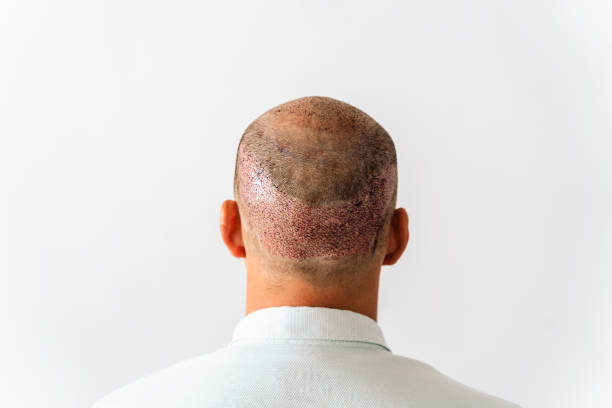

The evolution of hair restoration is defined by the transition from visible, linear scars to virtually undetectable micro-dots. For patients considering a hair transplant in Al Ain, the primary aesthetic goal is often twofold: achieving density at the front and maintaining a natural appearance at the back. In clinical settings, we observe that “scarless” surgery is a misnomer—all surgery creates some form of tissue change—but modern “Minimal Scarring” techniques ensure that these changes are invisible to the naked eye. By utilizing high-precision tools and refined extraction patterns, we can ensure that even with a short haircut, the evidence of your procedure remains your secret.
The Clinical Logic of Tissue Preservation
The key to minimal scarring lies in the diameter of the extraction tool and the depth of the incision. Older techniques utilized punches larger than 1.2mm, which often left visible white “pitting” in the donor area. Modern practitioners now favor micro-punches ranging from 0.7mm to 0.85mm. Our diagnostic-first philosophy emphasizes “Randomized Extraction,” a method where we harvest follicles in a scattered pattern rather than a straight line. This prevents “thinning rows” and ensures the donor area retains its original texture and hair distribution.
Is the Healing of Micro-Scars Uncomfortable?
What does the donor area feel like during the first week?
During the first 48 hours, the donor area—where the follicles were extracted—feels like a mild graze or “prickly” sensation. Because the incisions are so small, they do not require stitches and close naturally within hours. On a clinical scale, patients rate this discomfort as a 2/10. As the micro-scars heal, a temporary itching sensation is common, which signals that the skin is successfully remodeling.
Based on post-procedure follow-ups, what feels uncomfortable is the “tightness” of the scalp if a patient has a naturally low skin elasticity. However, what feels surprisingly easy is the “social recovery.” By day seven, the micro-scars in the donor area typically look like tiny red freckles that are easily hidden by the surrounding hair, allowing patients to resume their social lives in Al Ain without a “post-surgical” appearance.
“I was worried people would see the marks in the back of my head. But by day ten, even my barber couldn’t tell where the hairs were taken from. The Sapphire technique they used left almost no trace.” — Hassan
Step-by-Step: Technologies That Minimize Trauma
In clinical practice, we observe that the choice of blade material and shape directly impacts the “scarring footprint.”
-
Sapphire Blade Precision: Unlike steel, Sapphire blades are made from a single crystal, allowing for a much sharper, thinner edge. This creates a “V-shaped” incision rather than a “U-shaped” one, which results in less tissue displacement and faster closure.
-
Depth-Control Extraction: We use punches with built-in depth stoppers. This ensures we only go deep enough to reach the hair bulb, avoiding unnecessary trauma to the deeper dermal layers.
-
Intra-Operative Cooling: Keeping the scalp cool during the procedure reduces inflammation, which in turn prevents the “stretching” of micro-scars during the initial healing phase.
-
Platelet-Rich Plasma (PRP): Applying PRP to the donor area immediately after extraction accelerates cell regeneration, helping the micro-punches heal with minimal pigment change.
Managing the “White Dot” Phenomenon
Can FUE scarring be seen if I shave my head completely?
Safety and a diagnostic-first philosophy require an honest discussion about “Hypopigmentation.” If a patient has very dark skin or very light hair, the tiny circular scars may appear as faint white dots if the head is shaved with a razor (to the skin). To avoid this, we utilize “Diffused Harvesting,” ensuring that we never take adjacent follicles. This maintains the “camouflage” effect of the remaining hair, making the extraction sites invisible even at a Grade 1 or 2 buzz cut.
In the Al Ain climate, sun protection is vital for scar management. We advise all patients to avoid direct sun exposure on the donor area for the first month. UV rays can cause “post-inflammatory hyperpigmentation,” making the micro-scars appear darker than the surrounding skin. Following our diagnostic-first philosophy, we provide specialized UV-protective sprays to ensure the healing sites blend perfectly with your natural skin tone.
Frequently Asked Questions
Does ‘No-Shave’ FUE leave fewer scars?
The number of scars is the same, but they are immediately hidden by your existing long hair. This is an excellent option for patients who need to return to high-profile work in Al Ain immediately without showing any signs of surgery.
Will the scars disappear completely?
While no surgical incision disappears 100%, FUE micro-scars typically fade to the point where they are indistinguishable from natural skin pores. Within 6 to 12 months, they are usually undetectable even under close inspection.
Can I get a transplant if I am prone to Keloid scarring?
Keloid-prone patients require a “Test Patch” before a full transplant. We perform a small number of extractions and monitor the healing for 3 months. If no Keloid forms, we proceed with the full procedure using the most conservative micro-tools.
What is the ‘moth-eaten’ look, and how is it avoided?
This occurs when a surgeon takes too many hairs from one small area. We avoid this by using digital mapping to ensure an even “harvesting density” across the entire back and side of the head.
Does DHI (Direct Hair Implantation) leave less scarring than FUE?
DHI and FUE use the same extraction method, so the donor scarring is identical. However, DHI may result in slightly less trauma in the recipient area because it bypasses the “channel opening” step.
Why Choose Tajmeels Clinic for Your Procedure?
At Tajmeels Clinic, we believe that the best surgical work is that which remains invisible. We specialize in hair transplant in Al Ain by utilizing a diagnostic-first philosophy that prioritizes the long-term aesthetic of both your new hairline and your donor area. Our clinicians are masters of Sapphire FUE and DHI techniques, utilizing the finest micro-tools available in modern medicine to minimize tissue trauma. We provide a professional, empathetic environment, ensuring your hair restoration is as discreet as it is effective.