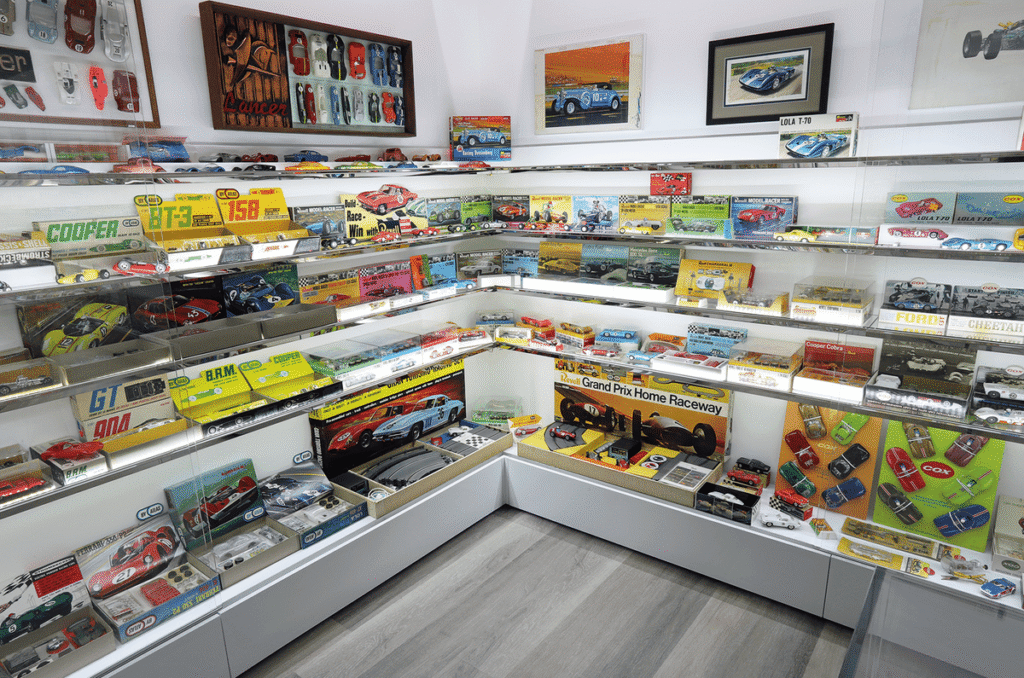

Most people don’t realize that one of the world’s most impressive slot car collections sits quietly above Sunset Strip. The Scott Bader Los Angeles collection represents more than 50 years of American racing culture, preserved in mint condition. You’ll find over 4,000 vintage slot cars here, many still in their original packaging from the 1960s. This isn’t a typical museum. It’s a time machine built by someone who lived through the golden age of slot racing.
The Golden Age Preserved in West Hollywood
Walk into this private museum and you’ll smell oil of wintergreen. That distinct scent filled commercial raceways throughout the 1960s. The museum pumps it through the air conditioning system on purpose. Twelve screens play vintage racing footage. Period music sets the mood. Every detail matters when you’re recreating 1963.
The main display room holds thousands of cars. Glass cases protect mint-boxed models from brands that defined an era. You’ll see Russkit, Revell, and K&B cars that never touched a track. Storage rooms contain five aisles of file drawers. Each drawer holds more treasures. An underground vault, reached by elevator, stores boxes of unopened cars. Climate control monitors keep humidity and temperature perfect.
This collection focuses on 1961 to 1973. Those years marked slot racing’s peak in America. Commercial tracks appeared on nearly every corner. At the height of this craze, between 3,500 and 5,000 tracks operated across the country. Kids and adults spent weekends racing. Tournaments drew crowds. The social phenomenon lasted only four years at its strongest, from 1963 to 1967.
From Childhood Dreams to World-Class Collection
The collector behind this museum grew up in Los Angeles during the 1960s. As a kid, he rode his bicycle to Revell Raceway. He started with a 1:24-scale Porsche 904 by Monogram. The hobby captured him, but he couldn’t afford the premium models available then. That frustration never left him.
He bought a 1969 Chevrolet Camaro and raced it at local dragstrips. Van Nuys Boulevard became his weekend ritual. Hundreds of car-obsessed teenagers cruised that strip together. These experiences shaped everything that came later.
Career demands pushed cars aside for years. He built Inline Distributing into the Western United States’ largest environmental remediation and construction supply company. Four decades as CEO required focus. But after 2000, he returned to his first love. Road racing beckoned. He drove a Porsche 911 GT3R professionally in IMSA and Rolex series events.
The slot car collection began seriously around 2008. By 2014, the custom-built facility opened. The physical museum took six years to complete. Every aspect received careful attention. The building design incorporated restoration shops, machining areas, and multiple levels connected by lifts.
What Sets This Collection Apart
Most collectors chase quantity. This collection prioritizes condition and completeness. Nearly every car comes with its original box, in pristine shape. Documentation accompanies each piece. Box art, advertising posters, and period catalogs fill the library.
You’ll find professional racing hand-built cars alongside mass-produced models. Technical curiosities sit near famous drivers’ personal cases. Team Russkit cases preserve history. Italian brands like Unicar, Mini Dream, and Policar represent international racing culture. Some models use rare acetate bodies instead of plastic.
The collection doesn’t stop at cars. Tools, controllers, power supplies, and track sections tell the complete story. Publications from the era provide context. Original advertising shows how manufacturers marketed these products. Every element contributes to understanding that brief, intense period when slot cars dominated American culture.
Access remains deliberately limited. The museum opens by appointment only, a few times yearly through a lottery system. This scarcity protects the collection. It also creates an exclusive experience for serious enthusiasts. Visitors who gain entry spend hours examining details. Curator Philippe de Lespinay guides tours personally.
Where Hobby Meets Business
The collector didn’t stop at building a museum. He acquired Electric Dreams, a slot car store in El Segundo. The shop opened in 1992 when vintage slot car demand suddenly exploded. Now it operates as one of the world’s largest dealers in racing slot cars.
Electric Dreams serves racers and collectors differently. Store hours run Tuesday through Friday, 9 AM to 5 PM. Saturdays open 10 AM to 3 PM. The six-lane Cunningham Raceway occupies part of the building. This 95-foot track supports both 1/24 and 1/32 scale racing. Customers get free track time with purchases.
The inventory spans decades. New products from major manufacturers fill shelves. Vintage items from the 1960s and 1970s stock other sections. Parts, tools, controllers, and race sets cover every need. The store ships orders daily to customers worldwide.
Real race car pieces decorate the walls. You’ll see components from Chuck Parson’s 1969 Can-Am Lola. Doors from Le Mans winning cars hang as art. Parts of Ronnie Peterson’s Formula One March sit on display. These full-size artifacts remind visitors that slot cars represent real racing history.
Full-Size Racing Machines Complete the Story
The collection extends beyond slot cars. A garage houses real race cars and muscle machines. Every vehicle connects to childhood memories or racing history. A 1964 Chevrolet Impala lowrider represents cruising culture. Exhibition dragsters recall weekend strip racing.
A yellow 1966 Corvette ranks among favorites. This particular car became the most successful mid-year Corvette in American B Production class racing. A blue 1967 Camaro Z/28 with 580 horsepower competed in Trans-Am series events. The 1969 Simoniz Lola T163-21 raced in Can-Am championships.
Formula racing machines include a black 1977 March 77B from Formula Atlantic. A Lola T294 sits nearby. The crown jewel might be Ronnie Peterson’s March 711-6. This car finished second in the 1971 Formula One World Championship. Owning it connects present-day enthusiasts to racing legends.
The garage itself deserves attention. Multiple levels allow vehicle movement via large lifts. Restoration shops contain machining equipment, welding stations, and woodworking tools. A CNC plasma cutter handles metal fabrication. Everything needed to maintain these machines exists on-site.
Visiting This Unique Collection
Getting inside requires planning. The museum doesn’t accept walk-ins. You must enter a lottery for appointment slots. Winners receive notification weeks in advance. Tours happen only a handful of times yearly. This exclusivity maintains the collection’s integrity.
When you do visit, expect several hours. The main display room alone contains thousands of items. Storage areas hold countless more. Every drawer opens to reveal new discoveries. Enthusiasts often lose track of time examining details.
The online museum at lascm.com offers an alternative. Photographs document the collection extensively. Information accompanies each item. While nothing replaces seeing these cars in person, the website provides substantial access.
How do I visit the slot car museum in Los Angeles?
The museum opens by appointment only through a lottery system. Check lascm.com for upcoming availability. Winners receive notification several weeks before tour dates.
What years does the collection focus on?
The collection emphasizes 1961 to 1973, particularly the peak years of 1963 to 1967 when slot racing dominated American culture.
Can I buy vintage slot cars from the collection?
The museum collection isn’t for sale. However, Electric Dreams in El Segundo offers vintage slot cars and new racing products for purchase.
Does the museum include full-size race cars?
Yes. The collection includes historic race cars like Ronnie Peterson’s 1971 Formula One March, Can-Am Lolas, and multiple muscle cars from the 1960s.
What makes this collection world-class?
Over 4,000 slot cars in mint condition, many in original packaging. The collection preserves complete sets, documentation, and period artifacts that tell the full story of American slot racing.