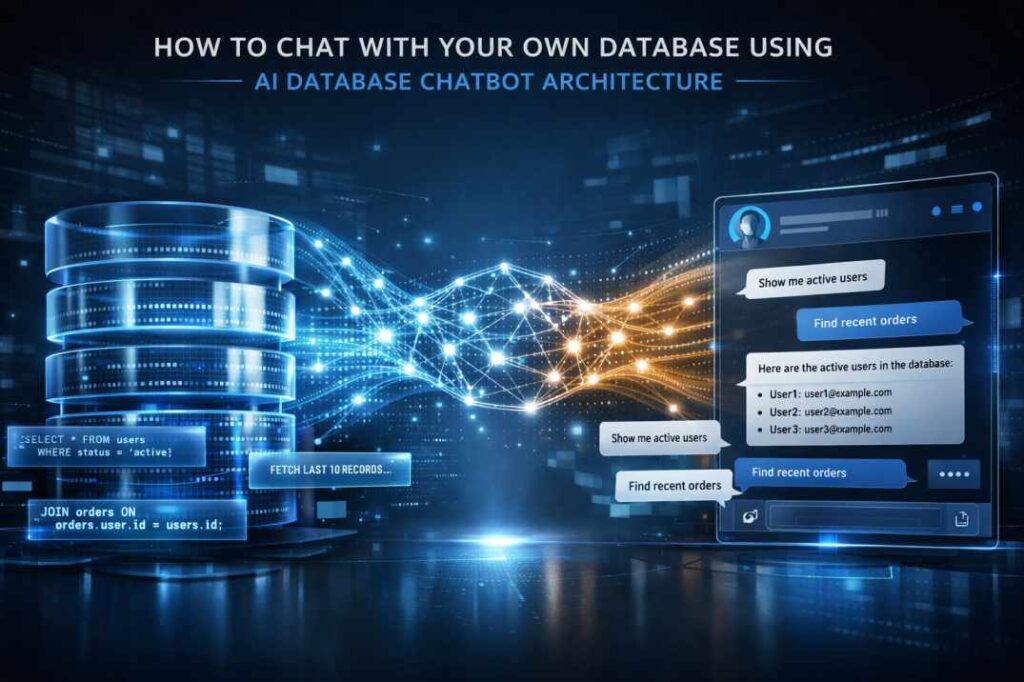

Organizations today operate in environments saturated with structured data. Financial systems record transactions down to the smallest unit, CRM platforms store behavioral histories, educational systems track performance metrics, and enterprise tools log operational activity in real time. Yet despite this abundance, accessing meaningful insights often requires technical mediation. Structured Query Language (SQL), business intelligence dashboards, and predefined reporting tools act as gateways to information, but they also create barriers. AI database chatbot architecture emerges as a structural response to this limitation, enabling users to interact with structured databases through natural language while preserving accuracy, governance, and performance.
The challenge is not that databases are insufficient; it is that their interfaces are rigid. Traditional access methods demand syntax precision, schema awareness, and technical familiarity. Most operational users think in questions, not in joins, filters, and aggregations. Bridging this gap requires more than a simple chatbot overlay. It requires an architectural framework capable of translating conversational intent into executable structured logic.
Understanding the Conceptual Foundation
Before exploring architecture in depth, it is essential to clarify what is database chatbot technology and why it differs from conventional conversational bots. A database chatbot is not a static FAQ responder. It is an intelligent intermediary layer that connects directly to structured data systems and dynamically generates queries based on user intent. Instead of retrieving prewritten answers, it interprets language, constructs database logic, executes queries, and returns data-backed responses.
This transformation depends on the integration of several coordinated systems:
-
Natural language understanding to interpret intent
-
Schema mapping to align business vocabulary with database structure
-
Query generation engines capable of producing valid SQL
-
Governance layers to protect sensitive data
-
Result interpretation modules to convert raw outputs into readable insight
The complexity lies in orchestration. Each component must function cohesively to maintain accuracy and trust.
The Core Architectural Layers
AI database chatbot architecture is not a single model but a layered system engineered to manage translation between human language and structured computation. Each layer performs a distinct function within the conversational pipeline.
Natural Language Understanding Layer
The entry point of the system involves processing user input using advanced language models. This layer identifies intent, extracts entities such as time periods or product categories, and preserves conversational context. For instance, if a user asks, “Show revenue for Q2,” and later follows with, “Break it down by region,” the architecture must retain memory of the Q2 timeframe. Without contextual continuity, the interaction becomes fragmented.
Intent detection is only one part of the equation. The system must also manage ambiguity. Human queries are rarely complete. Phrases like “How are we doing this month?” require inference about which metrics are relevant. Advanced conversational models evaluate context, user role, and historical queries to determine meaning while minimizing assumptions.
Semantic Mapping and Schema Intelligence
Human vocabulary does not mirror database design. A user may refer to “sales performance,” while the database stores fields labeled “gross_transaction_value.” To reconcile this disconnect, the architecture incorporates a semantic mapping layer that aligns conversational language with schema elements.
This layer typically includes:
-
Metadata catalogs describing table relationships
-
Synonym libraries mapping business terms to schema fields
-
Ontology structures defining hierarchies and dependencies
-
Contextual rules for interpreting domain-specific terminology
Without this translation bridge, even the most advanced language model cannot generate accurate structured queries.
Query Translation and Validation
Once intent and schema alignment are established, the architecture generates structured database queries. This process involves constructing syntactically correct SQL statements, defining joins between relational tables, applying filters, grouping results, and calculating aggregations.
Because AI-generated queries interact directly with production systems, validation mechanisms are critical. Effective architectures incorporate safeguards such as:
-
Syntax verification before execution
-
Logical consistency checks
-
Role-based access enforcement
-
Restrictions against write or destructive operations
These controls ensure that conversational convenience does not compromise system integrity.
Security and Governance Considerations
Conversational database access expands usability, but it also amplifies governance responsibilities. Structured data environments often contain sensitive financial, personal, or operational information. Allowing AI-generated queries to access such systems demands strict oversight.
Enterprise-grade architecture integrates layered protections, including role-based permissions, column-level masking, and activity logging. Every interaction can be recorded for audit purposes. Query logs provide traceability, ensuring that organizations maintain compliance with regulatory frameworks.
Security within conversational systems is proactive rather than reactive. Instead of responding to breaches, architecture is designed to prevent unauthorized access at the query generation stage. This layered governance model reinforces trust in AI-mediated data access.
AI Model Integration and Infrastructure Complexity
Behind the conversational interface lies significant engineering complexity. AI models must not only understand language but also reason within structured constraints. Domain adaptation is essential, particularly in industries with specialized terminology. Fine-tuning and contextual grounding ensure that the system interprets “net margin” differently from “gross revenue” or “operating cost.”
Implementing such systems often requires collaboration with teams offering AI development services capable of integrating language models with enterprise databases, middleware layers, and security frameworks. Infrastructure must support real-time inference while maintaining low latency and high reliability. Containerized deployments, API orchestration layers, and load-balancing mechanisms ensure that conversational systems scale effectively.
The integration challenge extends beyond model performance. Organizations must manage version control, update cycles, and continuous performance monitoring to maintain accuracy as data structures evolve.
From Data Retrieval to Insight Generation
Generating a correct SQL query is only one part of the process. The ultimate objective is insight. Raw numerical outputs rarely convey meaning on their own. A conversational architecture must interpret results and present them in a contextually relevant format.
For example, instead of displaying a table of monthly figures, the system may explain that revenue increased steadily over three months before declining due to seasonal shifts. It may highlight anomalies or compare performance across timeframes. This interpretive capability transforms structured data into actionable understanding.
The transition from data retrieval to narrative explanation represents one of the most significant advantages of conversational database systems. It shifts the interaction from transactional to analytical.
Enterprise Deployment and Database Chatbot Development
Designing conversational systems for enterprise use involves more than connecting a model to a single database. Large organizations operate across distributed environments, data warehouses, and multiple transactional systems. Effective database chatbot development requires architectural strategies capable of handling cross-system queries, federated data access, and unified semantic layers.
Scalable deployments often incorporate:
-
Middleware layers that abstract database complexity
-
Query caching to optimize performance
-
Horizontal scaling of AI inference systems
-
Monitoring frameworks to detect latency spikes
-
Failover mechanisms to preserve availability
Concurrency handling becomes particularly important as adoption grows. Dozens or hundreds of users may simultaneously interact with the system. Performance optimization must ensure that conversational queries do not degrade operational databases.
Common Challenges and Mitigation Strategies
Despite its transformative potential, AI database chatbot architecture faces implementation challenges. Poorly documented schemas complicate semantic mapping. Inconsistent naming conventions introduce translation ambiguity. Legacy systems may lack API compatibility, requiring modernization.
Data quality issues also affect reliability. If underlying data is incomplete or inaccurate, conversational outputs will reflect those weaknesses. Continuous data governance and schema maintenance are therefore integral to success.
Mitigation strategies include:
-
Conducting schema audits before deployment
-
Establishing metadata standards
-
Implementing user feedback loops to refine responses
-
Monitoring query accuracy and hallucination rates
-
Iteratively improving semantic alignment
A disciplined implementation roadmap significantly increases architectural robustness.
Strategic Impact on Organizational Decision-Making
Conversational database architecture fundamentally reshapes how organizations interact with information. By lowering technical barriers, it democratizes access to analytics. Operational teams no longer depend exclusively on analysts to extract insights. Decision cycles shorten because information retrieval becomes immediate and intuitive.
This shift does not eliminate the need for technical expertise. Instead, it elevates analytical roles toward modeling, forecasting, and strategic planning. Conversational systems handle routine data retrieval, allowing experts to focus on deeper interpretive work.
As AI reasoning capabilities evolve, these systems may move beyond reactive answering toward proactive insight generation. Predictive models can integrate with conversational layers, enabling users not only to ask what happened, but also what is likely to happen next.
Conclusion
AI database chatbot architecture represents a structural evolution in data interaction. By combining natural language processing, schema intelligence, secure query generation, and interpretive response mechanisms, it transforms rigid databases into accessible analytical partners. Through layered design and disciplined governance, conversational systems preserve the precision of structured data while eliminating technical friction.
The result is not merely a more convenient interface, but a redefinition of how organizations engage with their information ecosystems. Structured databases remain foundational, yet the pathway to insight becomes conversational, contextual, and increasingly intelligent.