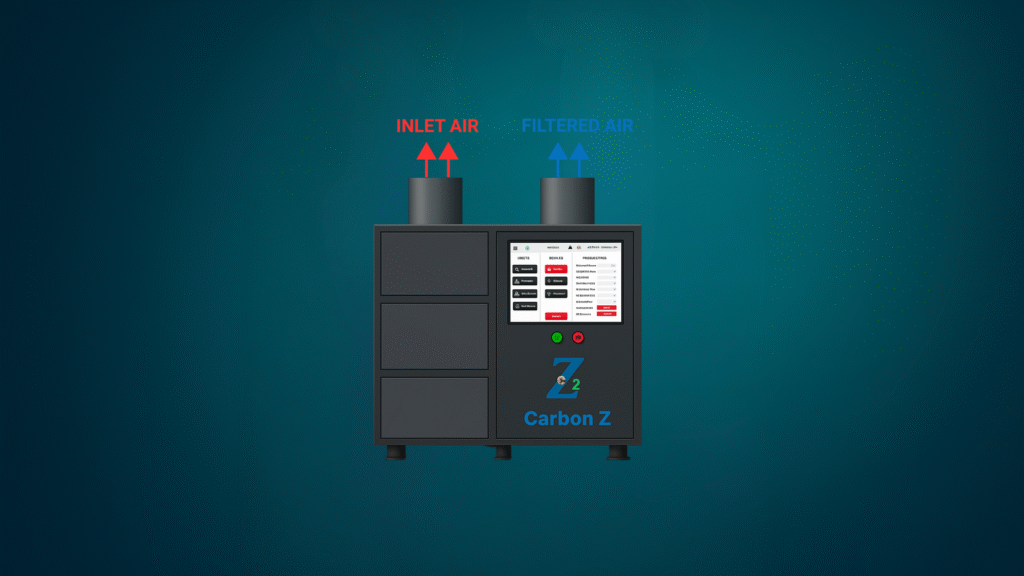

You’re hunkered down in your emergency shelter with family during a chemical leak or blast—doors sealed tight, no fresh air coming in. Hours pass, then a day. Heads throb, kids get drowsy, focus fades. That’s CO2 buildup turning safe refuge into danger zone. A CO2 removal system flips the script, scrubbing exhaled carbon dioxide to keep air breathable for days or weeks. At Sigma Power Tech, we’ve seen these save lives in factory drills and real NBC scares—20 people stayed clear-headed 72 hours sealed.
Why CO2 Buildup Kills Shelters Fast?
We breathe out CO2—roughly 0.5-1kg per person daily. Sealed shelters trap it: normal 0.04% jumps to 1% (drowsy), 3% (headaches), 5% (unconscious) in 12-24 hours for 10 people. Oxygen drops too, risking blackout. Without CO2 removal system, even O2 bottles fail long-term. Sensors trigger at 0.5%, but smart units auto-start earlier.
Industrial bunkers, home refuges—same threat. Fires spike CO2 worse.
Key Parts of a CO2 Removal System
Pro setups include:
- Sensors: Real-time CO2/O2 monitors (0.04-10% range), linked to shelter control system (SCS).
- Scrubber Beds: Soda lime or lithium hydroxide chemically trap CO2 (CO2 + H2O → carbonate).
- Blowers/Fans: 100-500 CFM circulate air through unit.
- Controls: PLC auto-activates, regenerates beds via heat.
Battery-powered for blackouts, integrates with NBC filters.
| Part | Job | Capacity |
| Sensors | Alert at 0.5% CO2 | Continuous |
| Beds | Absorb 1kg/person/day | 100-500 hrs |
| Fans | Full recirc 30min | DC backup |
| SCS | Auto cycle | Overpressure tie-in |
How CO2 Removal System Runs: Step-by-Step
- Monitoring: SCS sensors scan air. CO2 >0.5%? Alarm + auto-start.
- Air Pull: Blowers draw shelter air—no outside contaminants.
- Scrubbing: Air hits beds—CO2 binds (99% capture/pass). O2 stable.
- Clean Return: Filtered air recirculates, slight overpressure blocks leaks.
- Regeneration: Beds full? Shelter Control System heats (120°C) or vents H2O, resets for reuse—5x life.
Closed-loop: 7-30 days safe for 10-20 people.
Types for Emergency Shelters
- Chemical (Soda Lime): Fast absorb, manual swap—short stays.
- Regenerative (Zeolite): Auto-reuse, low consumables—long-term bunkers.
- Hybrid: Filtered intake + scrub—NBC threats.
Sigma picks regenerative for shelters—95% efficient, SCS-integrated.
Real Shelter Lifesavers: CO2 Removal System Wins
Factory NBC test: 15 workers sealed 96hrs, system held CO2 <0.8%. Home bunker drill: Family of 6, 48hrs comfy—no fatigue. Vs no system: CO2 hits 4% day 2, evacuation forced.
Install Your CO2 Removal System Right
- Site survey: Air volume, occupancy.
- Mount near SCS (wall/floor).
- Wire DC power, sensors.
- Calibrate, test cycle.
₹2-6 lakh, 1-2 days pro job. Links to shelter controls.
Keep CO2 Removal System Running Smooth
- Daily: Check indicators.
- Monthly: Filter clean, fan test.
- Quarterly: Bed regen cycle.
- Annual: Pro cal/service.
CO2 Removal System vs Basic Venting
| Method | Sealed Runtime | Contaminant Proof | Cost |
| CO2 Removal | Weeks | Yes (NBC) | Medium |
| Vent Only | Hours | No | Low |
| O2 Bottles | Days | Partial | High |
Scrubbers rule emergencies.
FAQs
Q. How long CO2 removal system lasts sealed?
Ans. 7-30 days/10 people.
Q. Power needed for CO2 removal system?
Ans. Fans yes (12V DC), chem no.
Q. Safe for kids in CO2 removal system shelter?
Ans. Yes—holds <1% CO2.
Q. CO2 removal system price for home shelter?
Ans. ₹1.5-4 lakh.
Q. What system removes CO2 from compressed air?
Ans. Dedicated CO2 removal units are deployed to remove unwanted traces of CO2 from the compressed air. These units feature a proven design similar to desiccant air dryers.
Q. What device removes CO2 from the air?
Atlas Copco offers dedicated CO2 removal units. These units are filled with a specialized zeolite and are qualified for both indoor and outdoor use, made of carbon steel or stainless steel.
Q. What chemical is used to remove CO2 in these units?
Ans. The CO2 removal units are filled with a zeolite that is specifically designed to remove CO2 from the compressed air.